
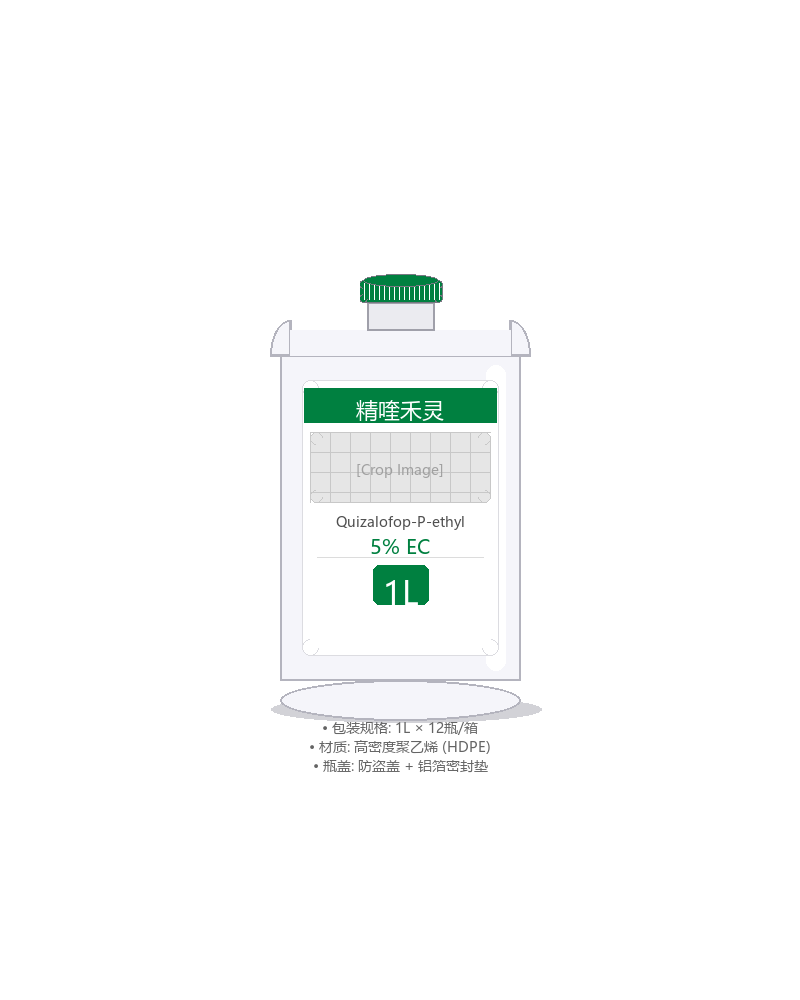
Quizalofop 5% emulsifiable concentrate
$0.00
quinquefoil (antifungal agent)
Out of stock
Find more products
Description
Quizalofop 5% emulsifiable concentrate
Quizalofop-P-ethyl 5% EC
Pesticide Category: Herbicides Dosage form: Emulsifiable concentrates (EC)| Toxicity: lower toxicity
CAS number: 100646-51-3 | Chemical Name: Ethyl (R)-2-[4-(6-chloroquinoxalin-2-yloxy)phenoxy]propionate
CAS number: 100646-51-3 | Chemical Name: Ethyl (R)-2-[4-(6-chloroquinoxalin-2-yloxy)phenoxy]propionate
I. Product Profile
Quinclorac 5% emulsifiable concentrate is aA Highly Selective New Herbicide for Stem and Foliar Application in Dryland Crops, belongs to the class of fluorooxyphenoxypropionic acid (FOP) herbicides. This product is a modified version of quinclorac; during the synthesis process, the inactive optical isomer (the L-isomer) was removed, leaving only the highly active R-isomer, and thereforeHigher activity, lower dosage, and more consistent efficacy. It is highly effective against grass weeds in broadleaf crop fields and exhibits high selectivity between grass weeds and broadleaf crops.
II. Mechanisms of action of active ingredients
Target: Acetyl-CoA carboxylase (ACCase) inhibitor
Quinclorac belongs toHRAC Class A / WSSA Class 1Herbicides with a mechanism of action:
forms
| active link | Specific mechanisms |
|---|---|
| absorption pathway | Mainly throughAbsorption by weed stems and leaves, within plantsUpward and downward bidirectional transmission |
| Conduction Pathways | Through vascular bundle transport, it accumulates inApical and Intercalary Meristems |
| biochemical target | Inhibition of acetyl-CoA carboxylase (ACCase) activity, inhibiting fatty acid synthesis |
| physiological effect | Interferes with the formation of cell membranes and the cuticle, inhibiting cell division and elongation |
| final performance | Weeds stop growing within 3 days; within 7 days, their leaves fade and their bases turn brown and wither; within 14 days, the entire plant dies. |
The Principle of High Selectivity
-
The ACCase enzyme in broadleaf crops (such as soybeans, cotton, and rapeseed) is insensitive to quinclorac, and the herbicide is rapidly metabolized and broken down.
-
ACCase enzymes in grass weeds are highly sensitive to quinclorac; accumulation of the herbicide leads to necrosis of the growing points.
-
Therefore, there is a relationship between grass weeds and dicotyledonous cropsHigh selectivity
III. Product characteristics
✅ Six Core Advantages
forms
| Specificities | particular |
|---|---|
| 🎯 Highly Active Refined Products | After removing the inactive isomers, its activity is 1–2 times higher than that of quinclorac, and it requires a lower application rate. |
| 🔄 Two-way transmission, completely eliminates | After being absorbed by the stems and leaves, the active ingredient is transported in both directions to the growing points, where it destroys the weeds from within. |
| ⏱️ Consistent results, unaffected by environmental factors | It improves absorption by plants and mobility within the plant, and is less susceptible to the effects of rain, temperature, and humidity. |
| 🛡️ Height Selection, Crop Safety | It is completely safe for broadleaf crops and can be used with confidence in fields of various dicotyledonous crops. |
| 🌾 Broad-spectrum weed control; effective against both grasses and broadleaf weeds | It provides excellent control of both annual and perennial grass weeds. |
| 🌱 Rapidly degrades in the soil, ensuring safety for subsequent crops | The half-life of degradation in soil isWithin a day...which is primarily degraded by microorganisms and has no impact on subsequent crops |
🎯 Preventing Objects
Annual grass weeds: Wild oats, barnyard grass, foxtail grass, golden foxtail grass, crabgrass, wild millet, cowgrass, wild rye, thrush grass, centipede grass, spelt, barley, multiflorous ryegrass, ergot, sorghum, and Kentucky bluegrass, among others.
Perennial grass weeds: Double-spiked barnyard grass, Bermuda grass, white grass, creeping ice grass, common reed, etc. (use slightly higher doses).
Suitable crops: Soybeans, sugar beets, rapeseed, potatoes, flax, peas, fava beans, tobacco, watermelons, cotton, peanuts, leafy vegetables, fruit trees, forest tree nurseries, alfalfa, etc.
IV. Usage and dosage
📋 Application Guidelines for Major Crops
forms
| Crop type | Application period | Dosage (formulated dose/acre) | water consumption | Mode of application |
|---|---|---|---|---|
| Soybean Field | When seedlings have 1–2 compound leaves; when grass weeds have 2–4 leaves | 50–70 milliliters per mu | 15–30 kilograms per mu | Foliar spray |
| Peanut Field | Early post-emergence stage; 3–5-leaf stage of grass weeds | 50–70 milliliters per mu | 30-50kg/mu | Foliar spray |
| Cotton Field | Early post-emergence stage; 3–5-leaf stage of grass weeds | 50–70 milliliters per mu | 30-50kg/mu | Foliar spray |
| Rapeseed Field (Transplanted) | After emergence, when the grass has 3–5 leaves | 60–70 milliliters per mu | 30-50kg/mu | Foliar spray |
| Rapeseed Field (Direct Seeding) | 6–8-leaf stage; 3–5-leaf stage for grasses | 60–70 milliliters per mu | 30-50kg/mu | Foliar spray |
| Watermelon/Melon Fields | Early post-emergence stage; 3–5-leaf stage of grass weeds | 50–70 milliliters per mu | 30-50kg/mu | Foliar spray |
| Broadleaf Vegetable Field | Early post-emergence stage; 3–5-leaf stage of grass weeds | 50–70 milliliters per mu | 30-50kg/mu | Foliar spray |
Application rates for perennial weeds: To control perennial grass weeds such as Bermuda grass, white grass, and reed, the application rate may be increased to 80–100 milliliters per mu。
V. Guidance for use
🔧 Application Points
forms
| move | operational specification |
|---|---|
| 1. Determine the age of the grass | Grass weeds2–5-leaf stageFor best results, apply the herbicide when the weeds are as young as possible. |
| 2. Select Weather | Apply the pesticide on windless or light-wind days to prevent drift. |
| 3. Spray method | Aim the spray at the stems and leaves of the weeds to ensure that the entire plant is covered with the herbicide. |
| 4. Water consumption | Mix 30–50 kilograms of water per mu, ensuring thorough and even application. |
| 5. Add additives | An appropriate amount of silicone or vegetable oil additives may be added to enhance the product's efficacy. |
⚠️ Key Considerations
-
⏰ Optimal application period: Grass weeds2–5-leaf stageTo ensure optimal application, increase the dosage or apply in multiple treatments when the weeds have reached the 5-leaf stage or beyond.
-
🚫 Contraindicated crops: this product has no effect onWheat, corn, rice, sorghum, millet, barleyGrass crops are highly sensitive; when applying the pesticide, be sure not to spray it onto nearby grass crops to avoid causing phytotoxicity.
-
🌧️ Impact of Rainfall: Rainfall within 4 hours of application may affect the efficacy of the pesticide, so a follow-up spray is required; rainfall more than 4 hours after application has little effect on efficacy.
-
🌡️ Environmental Conditions: Soil moisture, high relative humidity, and high temperatures promote the absorption and translocation of herbicides by weeds, resulting in greater efficacy.
-
🌿 Broadleaf weeds: This productIneffective against broadleaf weeds, In fields with severe broadleaf weed infestations, herbicides that are effective against broadleaf weeds should be applied in conjunction with other treatments.
-
🧪 Mixing Taboo: andHormone-based herbicides (2,4-D, 2,4-dichloroacetic acid, etc.)These products have an antagonistic effect and must not be mixed; they must also not be mixed with alkaline pesticides or substances.
-
🔄 Number of uses: Maximum use per growing season1–2 times, It is recommended to rotate this herbicide with others that have different modes of action.
-
🐟 Aquatic safety: Apply the pesticide away from aquaculture areas; do not wash application equipment in water bodies such as rivers or ponds.
-
🛡️ security: When applying the pesticide, wear long sleeves and long pants, gloves, a mask, and goggles; do not smoke, drink, or eat while applying the pesticide; wash your hands and face immediately after application.
-
📦 Storage conditions: Store in a sealed container in a dark place, away from direct sunlight and high temperatures.
Sixth, product specifications and packaging
forms
| sports event | parameters |
|---|---|
| Active ingredient content | Quinclorac ≥5% |
| exterior condition | A pale yellow to brownish-yellow transparent liquid |
| pH value | 5.0-8.0 |
| Emulsion Stability | Diluted 200 times to meet FAO standards |
| Packaging specification | 55 g × 200 pouches/case, 80 mL × 100 pouches/case, 100 mL × 50 bottles/case, 200 mL × 40 bottles/case, 500 mL × 20 bottles/case |
| date of use (on foodstuffs) | 2 years |
Warm Tip: When applying the product, please follow the guidance of your local plant protection authorities and adjust the application plan as appropriate based on the local weed community, weed growth stage, and climatic conditions.
Reviews
There are no reviews yet.