
Prochloraz 50% emulsifiable concentrate
$0.00
also called dimethoate
Out of stock
Find more products
Description
Prochloraz 50% emulsifiable concentrate
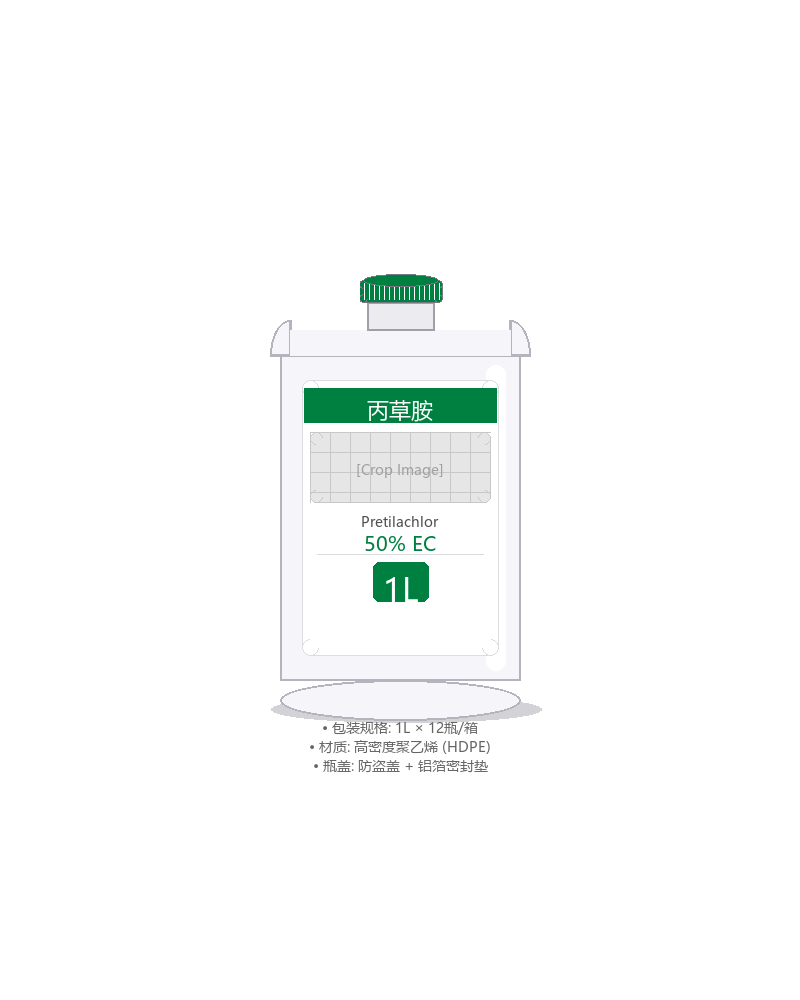
Pretilachlor 50% EC
CAS number: 51218-49-6 | Chemical Name: 2-Chloro-N-(2,6-diethylphenyl)-N-(2-propoxyethyl)acetamide
I. Product Profile
Propachlor 50% emulsifiable concentrate is aSelective pre-emergence soil-applied herbicides, which belongs to the class of systemic, translaminar amide herbicides. This product is a herbicide specifically formulated for rice fields and is primarily used to control annual grass weeds, sedges, and certain broadleaf weeds in rice fields (direct-seeded, transplanted, and seedling beds). Compared to butachlor, propachlor offers greater safety for rice,Typically used in combination with the safener desmedimide (CGA123407)...ensures the safe use of pesticides from seeding through the seedling stage and is the product of choice for pre-emergence weed control in rice fields.
II. Mechanisms of action of active ingredients
Target: Cell division inhibitor / Very-long-chain fatty acid (VLCFA) synthesis inhibitor
forms
| active link | Specific mechanisms |
|---|---|
| absorption pathway | Mainly throughWeed seedlings and coleoptilesAbsorption and transport within plants |
| biochemical target | Inhibit cell division, interfering with the synthesis of very-long-chain fatty acids (VLCFAs) |
| physiological effect | Inhibits the growth of young shoots and secondary roots and disrupts the normal division of meristematic cells |
| final performance | Weed seedlings die from poisoning before they emerge from the soil, or, if they do emerge, they grow abnormally, turn yellow, and wither. |
Safety Mechanisms in Rice
-
Propachlor, when applied alone, shows poor selectivity against wet-transplanted rice.
-
AddSafety agent CGA123407Afterward, it can activate the detoxification enzyme system within the rice plants, accelerating the metabolism and breakdown of the pesticide.
-
Therefore, it exhibits excellent selectivity for both transplanted and direct-seeded rice, and its safety profile is significantly superior to that of formulations that do not contain a safety agent.
III. Product characteristics
✅ Six Core Advantages
forms
| Specificities | particular |
|---|---|
| 🌾 Specifically formulated for rice; highly safe | Specially formulated for rice paddies, it contains the safety agent desmedimide and is safe for rice from sowing through the seedling stage. |
| 🔄 Pre-emergence control: Eradicate the problem at its root | It provides excellent control of young weed seedlings that have not yet emerged, preventing weed germination. |
| ⏱️ Moderate duration of effect; controllable and manageable | A single application of herbicide can effectively control weeds during the seedling stage of rice. |
| 🛡️ Highly selective and does not harm rice seedlings | At the recommended dosage, it has no adverse effects on rice growth and does not inhibit tillering. |
| 💧 Flexible and versatile | Can be applied as a spray or as a soil treatment; suitable for various cultivation methods and water conditions |
| 🎯 Broad-spectrum weed control; effectively eliminates both grasses and broadleaf weeds | Highly effective against grass weeds such as barnyard grass and foxtail, and also controls sedge and broadleaf weeds |
🎯 Preventing Objects
Primary prevention and eradication: Annual grasses, sedges, and broadleaf weeds such as barnyard grass, bald barnyard grass, common cocklebur, cowgrass, cowhair grass, narrow-leaved alisma, water amaranth, heteromorphic sedge, broken-grain sedge, clove smartweed, and duck’s-bill.
IV. Usage and dosage
📋 Rice field use program
forms
| Crop type | Application period | Dosage (formulated dose/acre) | water consumption | Mode of application |
|---|---|---|---|---|
| Rice direct seeding field | 2–4 days after germination and sowing | 80–115 milliliters per mu | 30 kilograms per mu | Spray or mix with fine, moist soil and apply |
| Rice transplanting field | 3–5 days before transplanting or 3–5 days after transplanting | 80–115 milliliters per mu | 30 kilograms per mu | Spraying or applying toxic soil |
| rice paddy | 2–4 days after sowing | 80–100 milliliters per mu | 30 kilograms per mu | Spraying or broadcasting with fine soil |
📋 Key Points on Application Techniques
forms
| sports event | operational specification |
|---|---|
| Field Conditions | Once the field is prepared, sow the seeds and apply pesticides promptly; the field surface should be level and free of standing water. |
| Water Body Management | When applying the pesticide, irrigate to a shallow depth or keep the soil moist; after application, keep the soil moist, and the field surfaceThere must be no standing water |
| Sowing Requirements | The rice seeds to be sown must have normal roots and sprouts,Avoid having buds but no roots |
| Poison Soil Technique | Mix the formulation at a rate of per mu20–30 kilograms of fine, moist soilMix well and spread evenly after the dew dries |
| Spray Method | Mix 30 kilograms of the product with water per mu and spray evenly onto the soil surface. |
Usage Instructions: The standard recommended dose is 50% propachlor emulsifiable concentrate 80–115 milliliters per mu. Excessive use of propachlor or propachlor that does not contain a safety agent can cause phytotoxicity in rice, manifested as severe stunting of plants, chlorosis and curling of the terminal leaves, and growth inhibition.
V. Guidance for use
🔧 Application Points
forms
| move | operational specification |
|---|---|
| 1. Quality of Land Preparation | The field surface must be level and finely tilled, free of large clumps of soil, to ensure even distribution of the pesticide. |
| 2. Seize the opportunity | Sow seeds and apply pesticides promptly after preparing the soil to prevent weeds from emerging prematurely and affecting the efficacy of the pesticides. |
| 3. Seed Quality | When using germinated seeds with normal roots and sprouts, seeds that have sprouts but no roots are prone to pesticide damage. |
| 4. Water Management | Keep the field moist but free of standing water; standing water can cause pesticide damage to rice seedlings. |
| 5. Apply the pesticide evenly | Whether using the spray method or the toxic soil method, make sure the pesticide is evenly distributed over the field. |
⚠️ Key Considerations
-
⏰ Grasp the application window: Must be done byBefore weeds emergePesticide application is less effective against weeds that have already emerged. In direct-seeding fields, apply the pesticide within 2–4 days after sowing.
-
💧 Water Management: Field Conditions After ApplicationThere must be no standing water... Standing water can increase the rice seedlings' absorption of the pesticide, leading to pesticide damage. Simply keep the soil moist.
-
🌱 Seed Requirements: The rice to be sown mustRoots and shoots are normalSeeds that have sprouted but have no roots are sensitive to pesticides and are prone to pesticide damage.
-
🌡️ Regional Differences: When using this product in northern rice-growing regions, the application period should be appropriately extended. Conduct small-scale trials first, followed by large-scale implementation, to prevent phytotoxicity.
-
🚫 Risk of Excess: Excessive use can cause rice plants to become severely stunted, with the young leaves losing their green color and curling, and a significant reduction in the root system, resulting in severely stunted growth; in severe cases, this can lead to seedling death.
-
🧪 Safety Agent Requirements: Be sure to useContains the herbicide agent diquatPropanamide formulations—those without safety agents—are less safe for rice.
-
🔄 Resistance management: It is recommended to rotate this product with herbicides that have different modes of action, such as diquat, oxazolamide, and ethofluoride, and to apply it no more than once per season.
-
🐟 Aquatic safety: Toxic to fish; do not use in rice paddies where fish are raised; do not wash application equipment in water bodies.
-
🛡️ security: Wear protective clothing, gloves, and a mask when applying the pesticide; wash your hands and face immediately after application; pregnant and breastfeeding women should avoid contact.
-
📦 Storage conditions: Store in a cool, dry place, away from direct sunlight and high temperatures.
Sixth, product specifications and packaging
forms
| sports event | parameters |
|---|---|
| Active ingredient content | Propachlor ≥50% (containing the safener diclofop) |
| exterior condition | Brownish yellow transparent liquid |
| pH value | 5.0-8.0 |
| Emulsion Stability | Diluted 200 times to meet FAO standards |
| Packaging specification | 100 mL × 50 bottles per case, 200 mL × 40 bottles per case, 500 mL × 20 bottles per case, 5 L × 4 buckets per case |
| date of use (on foodstuffs) | 2 years |
Warm Tip: When applying this product, please follow the guidance of your local plant protection authorities and adjust the application plan as appropriate based on local weed communities, cultivation practices, and climatic conditions.
📋 Quick Comparison Chart of Five Products
forms
| Diethylammonium chloride | Function Category | Mechanism of action | Primary Targets | Applicable crops | Key Features |
|---|---|---|---|---|---|
| Dichlorprop 900 g/L EC | Amides | Pre-emergence Soil Treatment | VLCFA Synthesis Inhibitors | Rice, corn, cotton, peanuts | High concentration, long-lasting effect, safe for rice |
| Isopropylamine 720 g/L EC | Amides | Pre-emergence Soil Treatment | Protein Synthesis Inhibitors | Corn, soybeans, peanuts, cotton, rapeseed | Broad-spectrum efficacy in dry-field conditions, safe for subsequent crops, and good compatibility with other pesticides |
| Quinclorac·Acetochlor 30% EC | Compound Preparations | Closed + Stems and Leaves | ACCase + VLCFA Inhibitor | Soybeans, peanuts, cotton, rapeseed, watermelon | One shot, one kill; dual-action; synergistic effect |
| Quinclorac 5% EC | Furoxyphenoxypropionic acid derivatives | Post-emergence Stem and Leaf Treatment | ACCase Inhibitor | Soybeans, cotton, peanuts, rapeseed, and leafy vegetables | High selectivity, bidirectional transport, rapid soil degradation |
| Propachlor 50% EC | Amides | Pre-emergence Soil Treatment | Cell division inhibitor | Rice (direct seeding, transplanting, seedling beds) |

Reviews
There are no reviews yet.