
Description
Oflumid·Acetochlor 40% Emulsifiable Concentrate
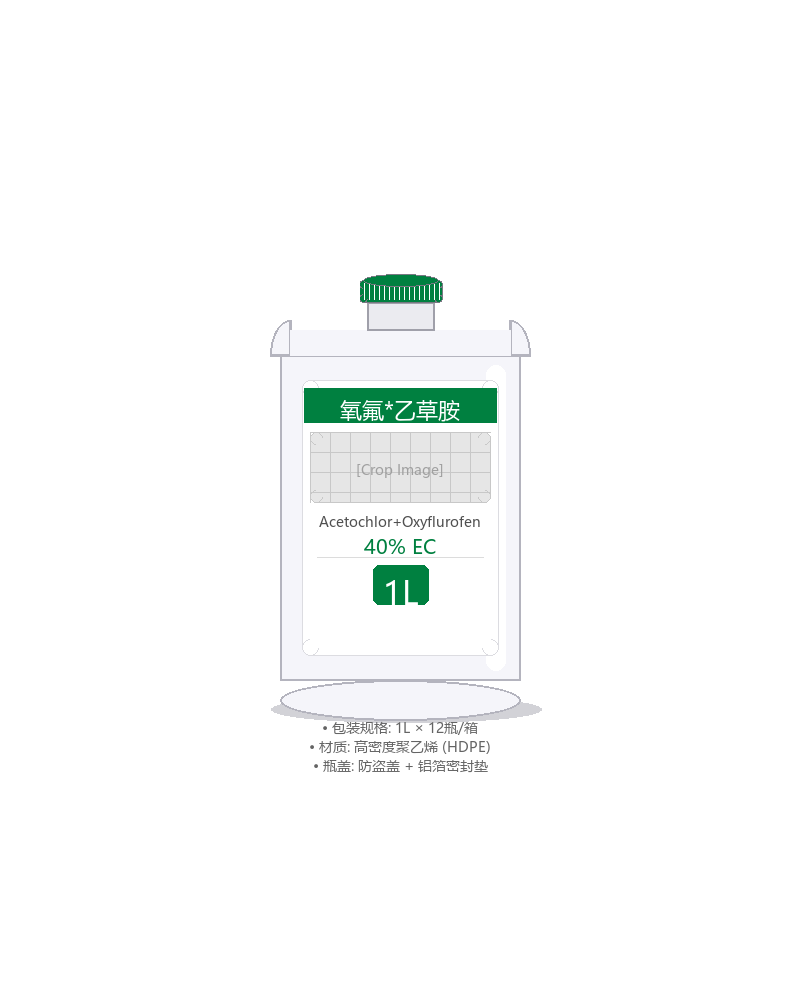
Oxyfluorfen + Acetochlor 40% EC
Active ingredients: Ethofluor + Acetochlor | Total active ingredient content: 40%
I. Product Profile
Oxfluorfen·Acetochlor 40% Emulsifiable Concentrate is aDual-component broad-spectrum herbicide, byFluorinated diphenyl ether contact herbicides (ethoxyfluorophenyl ether)andSystemic herbicides of the amide class (acetochlor)Scientifically formulated. This product combines both ”contact and systemic” weed control effects, rapidly killing emerged weeds through contact action while simultaneously preventing pre-emerged weeds from germinating via systemic translocation. This achieves a synergistic ”prevent and kill” effect, making it an effective solution for the integrated weed management of dryland crops such as soybeans, peanuts, cotton, corn, and other dryland crops.
II. Mechanisms of action of active ingredients
Mechanism of dual-target synergy
forms
| Ingredients | Function Category | mechanism of action | Mechanism of action |
|---|---|---|---|
| Ethofluor | HRAC Class E / WSSA Class 14 | Proporphyrin oxidase (PPO) inhibitors, interfering with chlorophyll synthesis | Contact action; can be used before or after bud break |
| also called dimethoate | HRAC Category K3 / WSSA Category 15 | Inhibitors of very-long-chain fatty acid (VLCFA) synthesis, interfering with cell membrane formation | Systemic, pre-emergence soil application |
The Principle of Synergy
-
Contact action (ethoxysulfuron): Under light conditions, this product inhibits PPO enzyme activity, leading to the accumulation of protoporphyrin IX, which generates singlet oxygen. This singlet oxygen damages cell membranes, causing rapid chlorosis and necrosis in weed leaves. It provides rapid control of early-stage post-emergence weeds and broadleaf weeds that have already emerged.
-
Chloridation (Atrazine): It is absorbed through the young shoots of weeds, inhibits the synthesis of very low-chain fatty acids (VLCFAs), and blocks cell membrane formation, preventing weeds from emerging or causing them to die after emergence. It provides excellent control of pre-emergent grass weeds.
-
Synergy: Ethofluoride compensates for the poor efficacy of acetochlor against emerged broadleaf weeds, while acetochlor compensates for ethofluoride’s short residual activity against pre-emergent weeds, thereby providing weed control throughout the entire growing season.
III. Product characteristics
✅ Six Core Advantages
forms
| Specificities | particular |
|---|---|
| 🎯 One shot, one kill—two benefits in one | It provides both soil-incorporated and foliar contact control, effectively managing both emerged and pre-emerged weeds. |
| 🔄 Broad-spectrum and highly effective, effectively controls both grass and broadleaf weeds | It provides excellent control of both annual grassy weeds and broadleaf weeds, with a broad spectrum of weed control. |
| ⏱️ Fast-acting and long-lasting | Ethofluoride takes effect within 3–5 days through contact action, while acetochlor provides residual control for 30–40 days. |
| 🛡️ Safe for crops, highly selective | Safe for crops such as soybeans, peanuts, and cotton at the recommended dosage |
| 💧 Synergies, Cost Reduction, and Quality Improvement | Dual-target action reduces the risk of resistance, lowers the dosage, and enhances overall control efficacy |
| 🌾 Versatile and flexible solutions | Suitable for a variety of crops, including soybeans, peanuts, cotton, corn, and vegetables |
🎯 Preventing Objects
Primary prevention and eradication: barnyard grass, crabgrass, foxtail grass, crabgrass, wild oats, quinoa, amaranth, purslane, knotweed, duckweed, black nightshade, cocklebur, ramie, field bindweed, thistle, and other annual grass and broadleaf weeds.
IV. Usage and dosage
📋 Application Guidelines for Major Crops
forms
| Crop type | Application period | Dosage (formulated dose/acre) | water consumption | Mode of application |
|---|---|---|---|---|
| Soybean Field | post-sowing before seedling | 100-150 ml/acre | 30-50kg/mu | Soil spraying |
| Peanut Field | post-sowing before seedling | 100-150 ml/acre | 30-50kg/mu | Soil spraying |
| Cotton Field | post-sowing before seedling | 100-150 ml/acre | 30-50kg/mu | Soil spraying |
| Cornfield | post-sowing before seedling | 100-150 ml/acre | 30-50kg/mu | Soil spraying |
| Rapeseed field | Before transplanting or after direct seeding in the field (pre-emergence) | 80–120 milliliters per mu | 30-50kg/mu | Soil spraying |
| Vegetable field | Before sowing or planting | 80–100 milliliters per mu | 30-50kg/mu | Soil spraying |
Dosage Instructions: Use the upper limit when soil organic matter content is high and weed density is high; use the lower limit for sandy soils with low organic matter content. Under dry conditions, increase the amount of water added or perform shallow tillage.
V. Guidance for use
🔧 Application Points
forms
| move | operational specification |
|---|---|
| 1. Field preparation | Before applying the pesticide, the soil should be leveled and finely tilled, free of large clumps and weed residues. |
| 2. Soil moisture | Apply by direct spraying when soil moisture is adequate; during dry periods, increase the amount of water added or mix it lightly into the soil. |
| 3. Dispensing methods | Using the two-step dilution method, first emulsify the chemical with a small amount of water, then add sufficient water. |
| 4. Spray Quality | Apply evenly to the soil surface, avoiding over-spraying or missed spots, to ensure a complete soil-pesticide layer is formed. |
| 5. Laminating Management | Apply plastic mulch immediately after spraying mulch-covered crops to enhance the efficacy of the pesticide |
⚠️ Key Considerations
-
⏰ Timing of application: This product is a pre-emergent herbicide and must be applied in theBefore weeds emergeApplying pesticides has limited effectiveness against weeds that have already emerged.
-
🌡️ Temperature and Light: Ethofluoride exhibits herbicidal activity under light conditions; therefore, adequate sunlight is required after application. Under high temperatures (>30°C), the application rate should be reduced appropriately.
-
💧 Soil conditions: For sandy soils and fields with low organic matter content, reduce the application rate slightly; for heavy clay soils and fields with high organic matter content, increase the application rate slightly.
-
🚫 Sensitive crops: 对Melons, tomatoes and fruitsThis product is sensitive to vegetables; exercise caution when applying it. It is toxic to grass family crops such as wheat and rice; take strict precautions to prevent drift.
-
🐟 Aquatic safety: Ethofluoride againstHigh fish toxicity(The LC₅₀ for rainbow trout is 0.3 mg/L); do not use in fish ponds; do not wash application equipment in water bodies.
-
🧪 Mixing Taboo: Do not mix with alkaline pesticides; avoid mixing with fast-acting contact herbicides such as paraquat.
-
🔄 Resistance management: It is recommended to rotate this product with herbicides that have different modes of action, and to use it no more than once per season.
-
🛡️ security: When applying the product, wear protective clothing, gloves, a mask, and goggles; wash your hands and face immediately after application; the product causes mild skin irritation and moderate eye irritation; avoid contact.
-
🧹 Instrument cleaning: Thoroughly clean the sprayer after use to prevent residual pesticide from causing phytotoxicity to subsequent sensitive crops.
-
📦 Storage conditions: Store in a cool, dry, well-ventilated place, away from direct sunlight and high temperatures; keep away from sources of fire and out of the reach of children.
Sixth, product specifications and packaging
forms
| sports event | parameters |
|---|---|
| Total active ingredient content | 40% (ethoxysulfuron + acetochlor) |
| exterior condition | Brownish yellow transparent liquid |
| pH value | 5.0-8.0 |
| Emulsion Stability | Diluted 200 times to meet FAO standards |
| Packaging specification | 100 mL × 50 bottles per case, 200 mL × 40 bottles per case, 500 mL × 20 bottles per case, 5 L × 4 buckets per case |
| date of use (on foodstuffs) | 2 years |
Warm Tip: For specific application, please use under the guidance of local plant protection department and adjust the dosing program appropriately according to local weed communities, soil types and climatic conditions.

Reviews
There are no reviews yet.