
Description
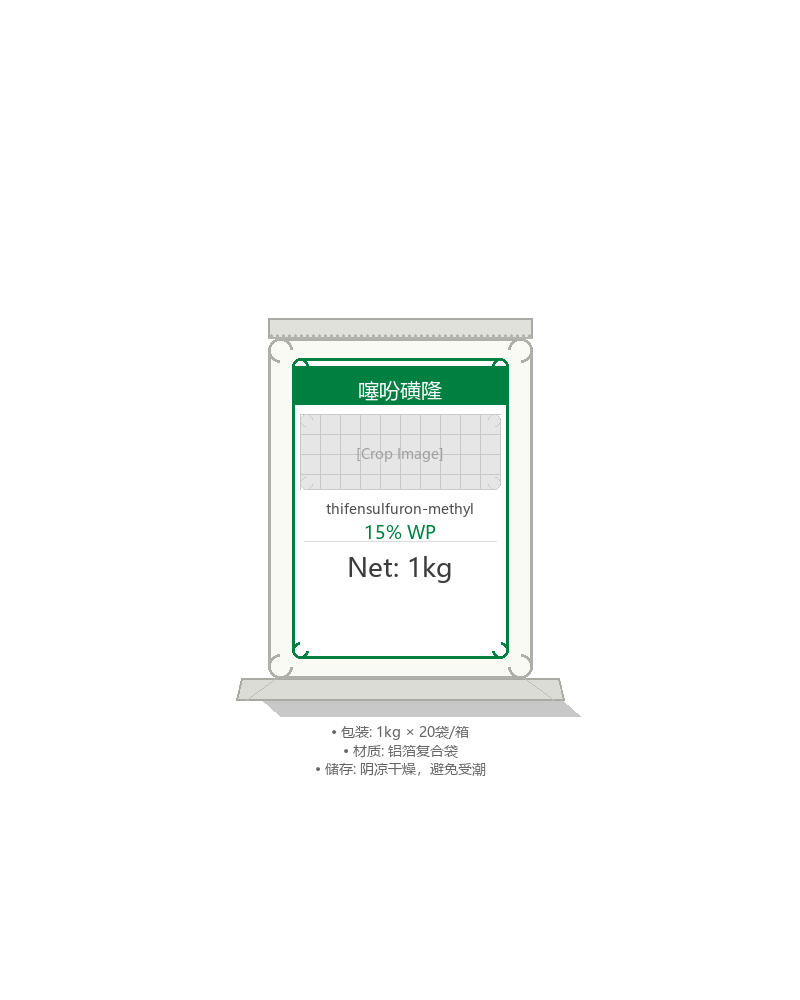
Thifensulfuron 15% WP
Thifensulfuron-methyl 15% WP
CAS number: 79277-27-3 | Chemical Name: 3-(3-methoxycarbonylthiophen-2-yl)-1-(N,N-dimethylaminocarbonyl)sulfonylurea
I. Product Profile
Thifensulfuron 15% Wettable Powder is aHighly effective, systemic, post-emergence selective herbicide, a sulfonylurea herbicide. This product is primarily absorbed and translocated through the leaves and roots of weeds; it inhibits the biosynthesis of valine, leucine, and isoleucine, thereby preventing cell division and causing susceptible weeds to cease growth and gradually die. It is primarily used to control annual broadleaf weeds in fields of cereal crops such as wheat, barley, oats, corn, and soybeans, and hasBroad-spectrum weed control; low toxicity and low residue; high efficacy; safe for both current and subsequent cropssuch features as.
II. Mechanisms of action of active ingredients
Target: Acetyl-L-lactate synthase (ALS) inhibitor
forms
| active link | Specific mechanisms |
|---|---|
| absorption pathway | Mainly throughUptake by weed leaves and roots, rapidly transmitted within the plant |
| biochemical target | Inhibiting the activity of acetyl-L-lactate synthase (ALS), inhibiting the synthesis of branched-chain amino acids |
| physiological effect | Inhibits the biosynthesis of valine, leucine, and isoleucine, and prevents cell division |
| final performance | Sensitive weeds stop growing immediately after exposure to the herbicide and gradually die off after one week. |
selectivity principle (physics)
-
The ALS enzyme in crops such as wheat, corn, and soybeans is insensitive to thifensulfuron or is able to rapidly metabolize and break down the herbicide.
-
The ALS enzyme in broadleaf weeds is highly sensitive to thifensulfuron; accumulation of the herbicide leads to growth arrest.
-
Therefore, among grass crops and broadleaf weeds, there isHigh selectivity
III. Product characteristics
✅ Six Core Advantages
forms
| Specificities | particular |
|---|---|
| 🎯 Broad-spectrum weed control, specifically targets broadleaf weeds | It is highly effective against a wide range of annual broadleaf weeds and is the herbicide of choice for controlling broadleaf weeds in cereal crops. |
| 🔄 Systemic action, thoroughly eradicates | After being absorbed through the leaves and roots, it is transported throughout the plant, destroying weeds from the inside out, with no regrowth. |
| ⏱️ Fast-acting and highly active | After application, susceptible weeds immediately stop growing and die within one week; the product’s efficacy is consistent. |
| 🛡️ Safe for the current crop, friendly to the next | Safe for wheat, corn, and soybeans; rapidly degraded by microorganisms under aerobic conditions in the soil; the next crop can be planted after 30 days |
| 💧 Low toxicity and low residue; eco-friendly | Low toxicity, low residue, environmentally friendly, and in line with the direction of green agriculture |
| 🌾 Flexible to use; can be applied both before and after seedling emergence | Both pre-emergence soil application and post-emergence foliar application are acceptable, and the application window is wide. |
🎯 Preventing Objects
Primary prevention and eradication: Common mugwort, reverse-branch amaranth, purslane, quinoa, dwarf quinoa, smartweed, shepherd’s purse, chickweed, pigweed, veronica, cow-parsnip, black nightshade, cocklebur, wolf’s-bane, devil’s-claw, groundsel, water-spiny-needle, pigweed, Chinese privet, prickly lettuce, lamb’s-quarters, ramie, duckweed, and other annual broadleaf weeds.
Not effective against the following weeds: Grass family weeds such as thistle, field bindweed, wild oats, foxtail, and barnyard grass.
Suitable crops: Winter wheat, spring wheat, durum wheat, barley, oats, corn, soybeans, etc.
IV. Usage and dosage
📋 Application Guidelines for Major Crops
forms
| Crop type | Application period | Dosage (formulated dose/acre) | water consumption | Mode of application |
|---|---|---|---|---|
| Winter Wheat Field | From the two-leaf stage after emergence to the ear-forming stage; weeds at the 2–4-leaf stage | 6–8 grams per mu | 30-40 kg/mu | Foliar spray |
| Summer Soybean Fields | Early post-emergence stage; weeds at the 2–4-leaf stage | 6–8 grams per mu | 30-40 kg/mu | Foliar spray |
| Summer Corn Fields | Early post-emergence stage; weeds at the 2–4-leaf stage | 6–8 grams per mu | 30-40 kg/mu | Foliar spray |
| Spring Soybean Fields (Northeast) | Early post-emergence stage; weeds at the 2–4-leaf stage | 8–10 grams per mu | 30-40 kg/mu | Foliar spray |
| Spring Corn Fields (Northeast) | Early post-emergence stage; weeds at the 2–4-leaf stage | 8–10 grams per mu | 30-40 kg/mu | Foliar spray |
Active ingredient dosage: For a single crop season on the same field, the application rate of the active ingredient thiophensulfuron should not exceed 32.5 grams per hectare(Approx. 2.2 grams per mu).
V. Guidance for use
🔧 Application Points
forms
| move | operational specification |
|---|---|
| 1. Determine the age of the grass | Among the weeds2–4-leaf stageFor best results, apply the herbicide when the weeds are as young as possible. |
| 2. Select Weather | Apply the pesticide on windless or light-wind days to prevent drift. |
| 3. Add additives | Maximum liquid capacity0.21 TP3T nonionic surfactant, to enhance the drug's efficacy |
| 4. Method of Dosing | Use the two-step dilution method to ensure that the chemical is thoroughly dispersed. |
| 5. Spray Quality | Apply the spray evenly, avoiding both over-spraying and missed spots, to ensure complete coverage of the entire weed plant. |
⚠️ Key Considerations
-
⏰ Optimal application period: The optimal time for application isEarly weed growth (up to 10 cm) and early crop growth...from the two-leaf stage after emergence until just before ear emergence.
-
🚫 Contraindicated crops: 对Broadleaf crops are sensitive, Take care not to contaminate the area during spraying to prevent phytotoxicity; avoid drift of the spray solution onto nearby broadleaf crops.
-
🌡️ Environmental Conditions: When crops are exposed to adverse environmental conditions (such as severe cold, drought, waterlogged soil, or pest and disease damage), pesticides should not be applied, as this may cause phytotoxicity.
-
💧 Soil conditions: Thifensulfuron shows no or very little mobility in soil; soil moisture conditions have little effect on its efficacy, but its effectiveness may decrease under drought conditions.
-
🐝 Bee Safety: Use with caution during the flowering season of nectar-producing crops to avoid affecting bees.
-
🧪 Mixing Taboo: Do not mix with alkaline substances such as pesticides.
-
🔄 Resistance management: It is recommended to rotate this herbicide with others that have different modes of action to delay the development of resistance.
-
🛡️ security: Wear protective clothing and gloves when applying the pesticide, and avoid inhaling the spray; do not eat or drink during application; wash your hands and face immediately after application.
-
🧹 Instrument cleaning: Spray equipment should be thoroughly rinsed several times after use to prevent pesticide residue from causing phytotoxicity to subsequent sensitive crops.
-
📦 Storage conditions: Store in a cool, dry, well-ventilated place, away from direct sunlight and high temperatures; keep away from sources of fire and out of the reach of children.
Sixth, product specifications and packaging
forms
| sports event | parameters |
|---|---|
| Active ingredient content | Thifensulfuron ≥15% |
| exterior condition | White to pale yellow powder |
| Suspension rate | ≥70% |
| Wetting time | ≤120 seconds |
| Packaging specification | 20 g × 100 bags/case, 50 g × 100 bags/case, 100 g × 50 bags/box, 500 g × 20 bags/box |
| date of use (on foodstuffs) | 2 years |
Warm Tip: When applying this product, please follow the guidance of your local plant protection authorities and adjust the application plan as appropriate based on local weed communities, crop varieties, and climatic conditions.

Reviews
There are no reviews yet.