
Description
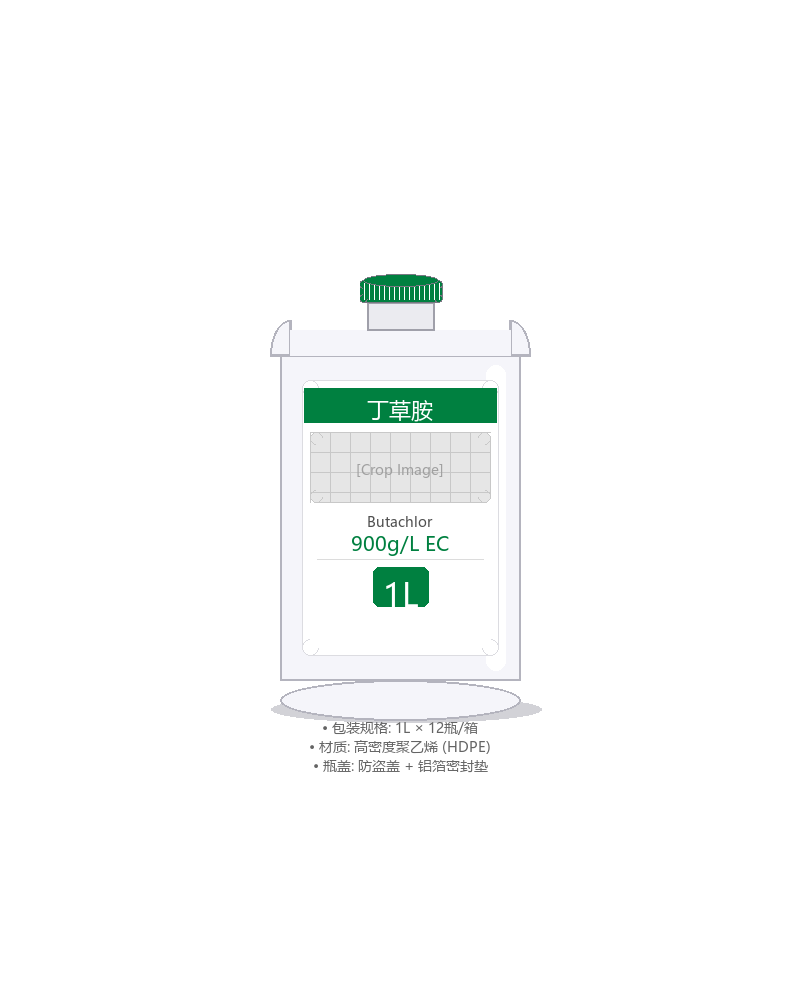
Butachlor 900 g/l emulsifiable concentrate
Butachlor 900g/L EC
Pesticide Category: Herbicides Dosage form: Emulsifiable concentrates (EC)| Toxicity: lower toxicity
CAS number: 23184-66-9 | Chemical Name: N-(Butoxymethyl)-2-chloro-N-(2,6-diethylphenyl)acetamide
CAS number: 23184-66-9 | Chemical Name: N-(Butoxymethyl)-2-chloro-N-(2,6-diethylphenyl)acetamide
I. Product Profile
Butachlor 900 g/l emulsifiable concentrate is aHighly effective, low-toxic selective pre-emergence herbicideIt belongs to the amide class of systemic conductive herbicides. This product is mainly used in rice field (direct seeding field, transplanting field) to prevent and eliminate annual grass weeds and some broad-leaved weeds, with the following characteristicsWide herbicide spectrum, long persistence period, high safety for riceand other characteristics make it a classic choice for weed management in rice fields.
II. Mechanisms of action of active ingredients
Target of action: Inhibitor of very long chain fatty acid (VLCFA) synthesis
Butachlor belongs toHRAC Category K3 / WSSA Category 15Herbicides with a mechanism of action:
forms
| active link | Specific mechanisms |
|---|---|
| absorption pathway | Mainly through weedsYoung shoots and germinal sheathsuptake, followed by uptake through young roots and internal conduction to the whole plant |
| biochemical target | Inhibition in plantsSynthesis of very long chain fatty acids (VLCFA), interferes with fatty acid metabolic pathways |
| physiological effect | Blocking the normal formation of cell membrane and wax layer, inhibiting cell division and elongation |
| final performance | Weed shoots fail to emerge properly, or grow abnormally, yellow, wither and die after emergence |
selectivity principle (physics)
Rice is naturally resistant to butachlor: after absorbing a small amount of the agent, the rice seedling is able toRapid and complete breakdown and metabolismThe plant is not a toxicant, and therefore does not become toxic; whereas young weed shoots lack this metabolizing ability, resulting in death by poisoning.
III. Product characteristics
✅ Six Core Advantages
forms
| Specificities | particular |
|---|---|
| 🌾 Pre-emergence closure to eliminate roots | Excellent control of young weed shoots that have not yet emerged from the ground, ”sealing and killing”, with limited effect on weeds that have already grown out of the ground. |
| 🔄 systemic conductance, whole-plant killing | The agent is absorbed by the young shoots and transmitted to the whole plant, completely destroying the weeds from the growing point without rebound. |
| ⏱️ Long lasting, one time for the whole season. | It can be adsorbed by colloid in the soil, not easy to leach, and the holding period can reach30-60 daysA single application provides basic control of weed infestation throughout the rice life cycle. |
| 🛡️ Rice safe and secure | Good selectivity to rice direct seeding and transplanting fields, safe to apply after seedling restoration. |
| 🎯 Gramineae Specialty, Precision Weed Control | Special effect on annual grass weeds such as barnyardgrass, goldenrod, matang, etc., and also treats some sedge and broadleaf weeds. |
| 💧 High-content formula saves labor and money | 900g/L high content of emulsifiable concentrate, compared with the traditional 60% emulsifiable concentrate, less dosage, more stable efficacy, more cost-effective. |
🎯 Preventing Objects
Primary prevention and eradication: Barnyardgrass, miller's sedge, matang, dogwood, oxalis, shaped sedge, shredded rice sedge, duckweed, knapweed, strangler, and other annual grassy weeds, sedge family, and some broadleaf weeds.
Not effective against the following weeds: Perennial weeds such as eyedropper, zephyr, dwarf cichlid, watercress, greenbrier, purplebrier, and most broadleaf weeds.
IV. Usage and dosage
📋 Rice field use program
forms
| Crop type | Application period | Dosage (formulated dose/acre) | water consumption | Mode of application |
|---|---|---|---|---|
| Rice transplanting field | 5-7 days for early rice and 3-5 days for late rice after transplanting (after slowing down) | 83-142 ml/acre | 30-40 kg/mu | Spraying or spreading with toxic soil |
| Rice direct seeding field | 3-5 days after sowing (before needle establishment period) | 100-150 ml/acre | 30-50kg/mu | Spraying or spreading with fine soil |
| rice paddy | 2-3 days before sowing or at 1-leaf-1-heart stage of seedlings | 75-125 ml/acre | 35-50 kg/mu | topsoil spray |
📋 Reference for use in dryland crops
forms
| crop | Application period | Dosage (formulated dose/acre) | water consumption |
|---|---|---|---|
| maize | post-sowing before seedling | 100-150 ml/acre | 40-50 kg/mu |
| wool | post-sowing before seedling emergence | 100-150 ml/acre | 40-50 kg/mu |
| Peanuts, soybeans | post-sowing before seedling | 100-150 ml/acre | 40-50 kg/mu |
| Vegetables (cabbage, kale, etc.) | Before sowing or planting | 100-150 ml/acre | 40-50 kg/mu |
Conversion Notes: 900g/L emulsifiable concentrate per acre active ingredient dosage is 75-128 g/mu(based on 83-142 ml/acre), equivalent to 60% emulsifiable concentrate 125-213 ml/acre The level of defense effectiveness of the
V. Guidance for use
🔧 Application Points
forms
| move | operational specification |
|---|---|
| 1. Field preparation | Ensure that the field is level and fine, free of large soil clods and weed residues before application |
| 2. Aquifer management | Transplanting field maintenance3-5 cm shallow water layerPost-application water retention5-7 daysNo drainage or string irrigation during the period; direct seeded fields retain water for 2-3 days after application before draining for seeding |
| 3. Dispensing methods | adoptionsecondary dilution: Emulsify the agent fully with a small amount of water first, then add enough water to mix well |
| 4. Poisonous soil method | Use preparations per acre with20-30 kg of moist, fine soilMix well and spread evenly after the dew dries |
| 5. Spraying | Choose a fan-shaped nozzle, evenly spraying the soil surface, to avoid heavy spraying leakage |
⚠️ Key Considerations
-
⏰ Grasp the application window: This product is a pre-emergent herbicide and must be applied in theWeeds before the one-leaf stage and before the three-leaf stageApplication of medicine, the effect of barnyard grass above the three-leaf stage is poor. Rice transplanting field should be applied as early as possible after seedling slowing down, and the direct seeding field should be completed before the needle standing period.
-
🌡️ temperature management: Application rates should be appropriately reduced during periods of continuous high temperatures (>30°C); slow weed germination under low temperatures may delay application appropriately.
-
💧 Humidity requirements: Higher relative humidity in the field at the time of application results in better weed control. The upper dose limit should be used under drought conditions and ensure that the soil is moist.
-
🚫 Contraindicated crops: The effect of butachlor onWheat, barley, corn, sorghumIt has strong killing effect on grass crops, etc. When applying the drug, strictly prevent the fog droplets from drifting.Melons, tomatoes and fruitsVegetable sensitivities, use with caution.
-
🐟 Aquatic safety: this product has no effect onHigh fish toxicityThe water in the field after application shall not be directly discharged into rivers, ponds, lakes and other waters, and the wastewater from the cleaning of medicinal instruments shall be properly disposed of.
-
🧪 Mixing Taboo: not be associated withButyl 2,4-dichlorodiphenyl ether, 2-methyl-4-chlorideand other hormone herbicides (antagonism, reduce efficacy); avoid mixing with paraquat and other fast-touch herbicides (affect conduction absorption).
-
🔄 Resistance management: Long-term single use is prone to resistance, it is recommended to combine withEthofluralin, oxaflutole, ethoxysulfuronRotate or mix herbicides with different mechanisms of action, such as the following, up to 1 application per season.
-
🛡️ security: Wear protective clothing, gloves, masks and boots when applying; wash hands and face promptly after application; avoid contact with pregnant and lactating women.
-
🧹 Instrument cleaning: Thoroughly clean the sprayer after use to avoid residual liquid damage to other crops.
-
📦 Storage conditions: Store in a cool and dry place, avoid direct sunlight; Crystallization may occur at temperatures below -10℃, and the efficacy will not be affected by heating and dissolving with 40℃ warm water.
Sixth, product specifications and packaging
forms
| sports event | parameters |
|---|---|
| Active ingredient content | Butachlor ≥900g/L |
| exterior condition | Brownish yellow transparent liquid |
| pH value | 5.0-8.0 |
| Emulsion Stability | Diluted 200 times to meet FAO standards |
| Packaging specification | 200mL×50bottles/box, 500mL×20bottles/box, 5L×4buckets/box, 200L/bucket |
| date of use (on foodstuffs) | 2 years |
Warm Tip: For specific application, please use under the guidance of local plant protection department and adjust the dosing program appropriately according to local weed communities, soil types and climatic conditions.

Reviews
There are no reviews yet.