
Description
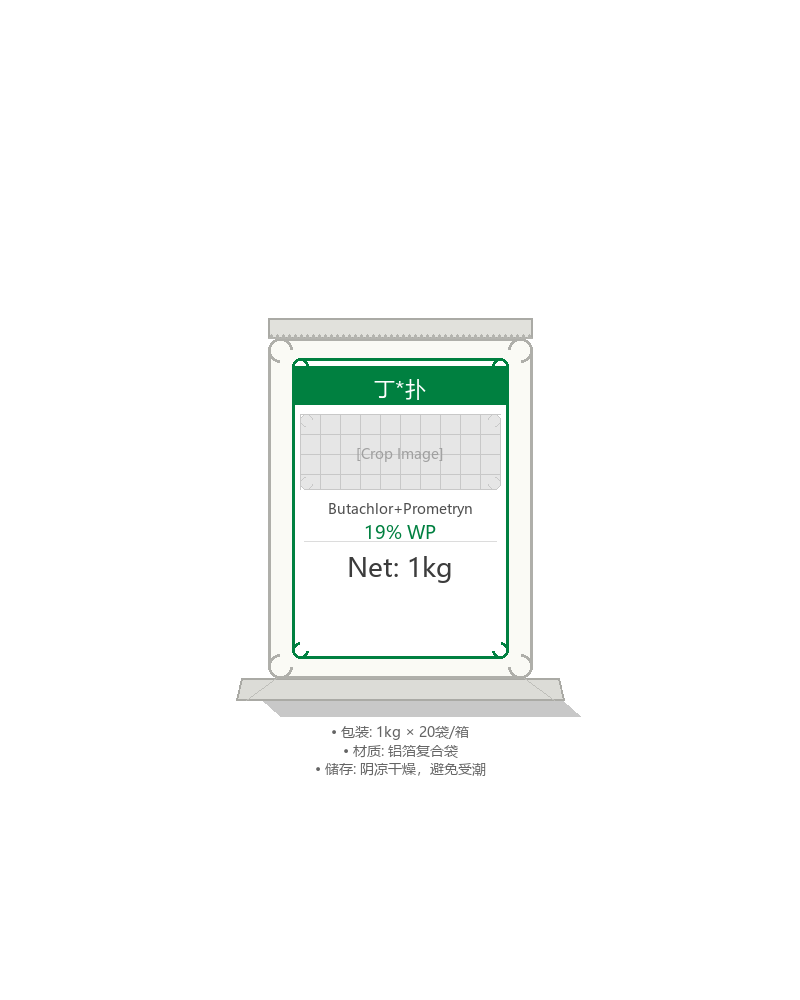
Ding*Puff 19% Wettable Powder
Butachlor + Prometryn 19% WP
Active ingredients: Dichlorprop + Propanil | Total active ingredient content: 19%
I. Product Profile
Ding Pu 19% Wettable Powder is aBinary Formulation Herbicide Specifically Designed for Rice Fields, byAmide-type pre-emergence herbicide (butachlor)andTriazine-class photosynthesis inhibitors (Pucaoqing)Scientifically formulated. This product combines the dual effects of ”surface-acting and systemic” action, providing excellent control of annual grassy weeds, broadleaf weeds, and sedge weeds in rice fields. It is a classic product for the comprehensive management of weeds in transplanted rice fields.
II. Mechanisms of action of active ingredients
Mechanism of dual-target synergy
forms
| Ingredients | Function Category | mechanism of action | Mechanism of action |
|---|---|---|---|
| butachlor | HRAC Category K3 / WSSA Category 15 | Protein Synthesis Inhibitors, inhibiting absorption by young shoots and secondary roots | Pre-sprout soil treatment; absorption by young sprouts |
| Weed Killer | HRAC Class C1 / WSSA Class 5 | Photosynthesis Inhibitor (PSII), blocking electron transfer | Systemic; absorbed primarily through the root system |
The Principle of Synergy
-
Grass Weed Control (Dichlorprop): It is primarily absorbed through the young shoots and secondary roots of weeds, inhibiting protein synthesis within the plants, causing the young weeds to become swollen and deformed with a deep green color, and ultimately leading to their death. It is highly effective against barnyard grass, common ragweed, heteromorphic sedge, rice sedge, and cowhage.
-
Broadleaf Cyperus Control (Pucao Jing): This is a triazine-class systemic herbicide that is primarily absorbed through the roots of weeds, though it can also be absorbed through stems and leaves. It inhibits photosynthesis in weeds, causing them to lose their green color and die. It provides good control against broadleaf weeds such as duckweed, cowhage, and water milfoil, as well as sedge weeds.
-
Synergy: Dichlorprop compensates for the limited effectiveness of haloxyfop against grass weeds; haloxyfop compensates for dichlorprop’s poor effectiveness against broadleaf and sedge weeds, thereby achieving complete control of all grass, broadleaf, and sedge weeds in rice fields.
III. Product characteristics
✅ Six Core Advantages
forms
| Specificities | particular |
|---|---|
| 🎯 Completely eliminates He Kuosha; broad-spectrum and highly effective | It provides good control of annual grass weeds, broadleaf weeds, and sedge weeds. |
| 🔄 Enclosed and systemic—double protection | It combines the dual effects of soil-applied and systemic action, providing control against both emerged and pre-emerged weeds. |
| ⏱️ Long-lasting, one application lasts | A Single Application of Pesticide Effectively Controls Weed Damage During the Seedling Stage of Rice |
| 🛡️ Safe for rice, highly selective | At the recommended dosage, it is safe for transplanted rice fields and does not affect tillering or yield. |
| 💧 Flexible and versatile | Can be mixed with soil and broadcast-applied; suitable for transplanted field cultivation systems |
| 🌾 Classic formula, consistent results | Ding-Pu Compound is a classic weed control formula for rice paddies, with its effectiveness proven over many years. |
🎯 Preventing Objects
Primary prevention and eradication: Annual grass weeds, broadleaf weeds, and sedge weeds, such as barnyard grass, golden needle grass, cowhair grass, odd-leaved sedge, broken-grain sedge, duck’s-bill sedge, water milfoil, jointed waterweed, field waterweed, water amaranth, and water-snake grass.
IV. Usage and dosage
📋 Implementation Plan for Rice Transplanting Fields
forms
| Application period | Dosage (formulated dose/acre) | Water Body Management | Mode of application |
|---|---|---|---|
| 5–7 days after transplanting | 200–300 grams per mu | Maintain a water level of 3–5 cm for 7–10 days | Mix with 20 kilograms of moist, fine soil and broadcast it |
Active ingredient dosage: The recommended application rate of active ingredient per mu for 19% Ding·Pu is 38–57 grams per mu. Maintain a shallow layer of water (3–5 cm) in the field during application, and keep the water in the field for 7–10 days after application.
V. Guidance for use
🔧 Application Points
forms
| move | operational specification |
|---|---|
| 1. Seize the opportunity | Apply the herbicide 5–7 days after rice transplanting, when the seedlings have become established but weeds have not yet emerged in large numbers. |
| 2. Field Preparation | Level the field and maintain a shallow water layer of 3–5 cm. |
| 3. Aquifer Management | Maintain a water depth of 3–5 cm in the field during application, and keep the field moist for 7–10 days after application; do not allow the spray solution to run off. |
| 4. Preparation of Medicinal Soil | Mix the formulation with 20 kilograms of moist, fine soil per mu, and apply it evenly after the dew has dried. |
| 5. Apply the pesticide evenly | Ensure that the pesticide is evenly distributed over the field to avoid over-spraying or missed spots. |
⚠️ Key Considerations
-
⏰ Optimal application period: After rice transplanting5-7 daysThis is the optimal time for application; applying too early may cause phytotoxicity, while applying too late, when weeds have already emerged, will reduce the effectiveness of the pre-emergence treatment.
-
💧 Water Management: When applying the pesticide, the field must be3–5 cm of shallow water, and maintain7–10 days, and do not let the solution spill.
-
🚫 Unsuitable soils: Sandy soils and soils with low organic matter content are prone to pesticide damage and should not be used.。
-
🌡️ Strict Dosage: Strictly adhere to the recommended application rate and timing; otherwise, phytotoxicity may occur.
-
🐟 Aquatic safety: Apply the pesticide away from aquaculture areas, and do not wash application equipment in water bodies such as rivers or ponds.
-
🧪 Mixing Taboo: Do not mix with alkaline substances such as pesticides.
-
🔄 Number of uses: Maximum use per growing season1 time。
-
🛡️ security: Wear protective clothing, gloves, and a mask when applying the pesticide; wash your hands and face immediately after application; pregnant and breastfeeding women should avoid contact.
-
🧹 Instrument cleaning: Clean spray equipment thoroughly after use to prevent residual pesticide from causing phytotoxicity to other crops.
-
📦 Storage conditions: Store in a cool, dry, well-ventilated place, away from direct sunlight and high temperatures; keep away from sources of fire and out of the reach of children.
Sixth, product specifications and packaging
forms
| sports event | parameters |
|---|---|
| Total active ingredient content | 19% (Butachlor + Propachlor) |
| exterior condition | Grayish-white to pale yellow powder |
| Suspension rate | ≥70% |
| Wetting time | ≤120 seconds |
| Packaging specification | 200 g × 50 bags per case, 500 g × 20 bags per box |
| date of use (on foodstuffs) | 2 years |
Warm Tip: When applying this product, please follow the guidance of your local plant protection authorities and adjust the application plan as appropriate based on local weed communities, cultivation practices, and climatic conditions.
Reviews
There are no reviews yet.