
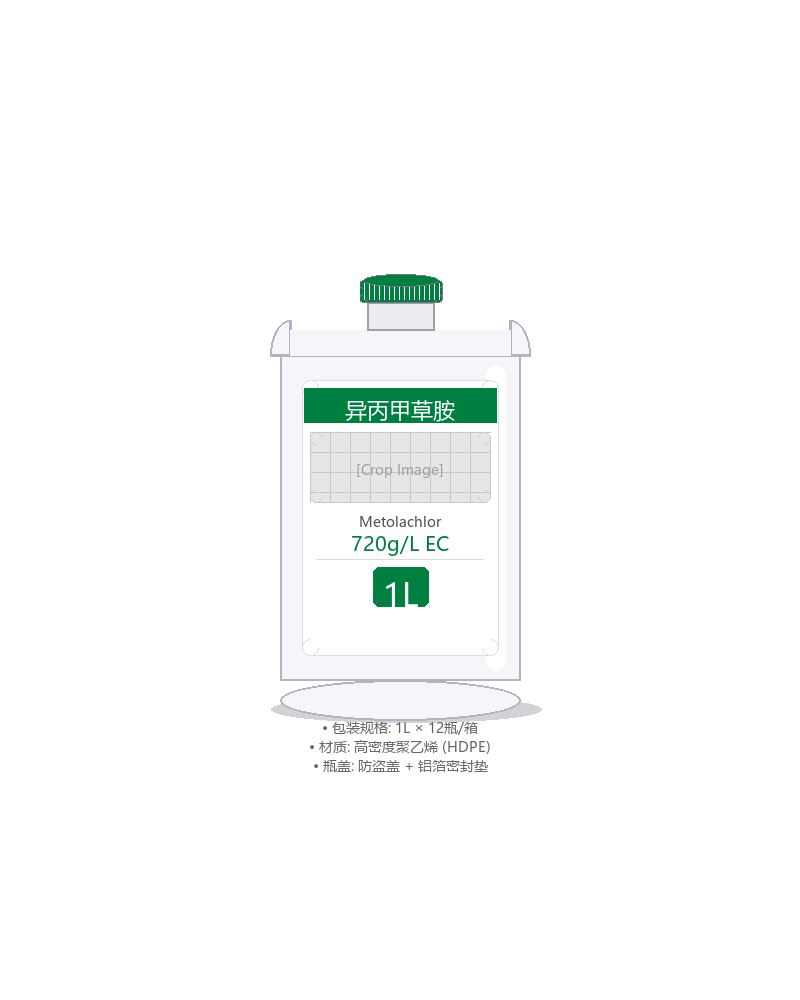
Isopropylmethachlor 720 g/l emulsifiable concentrate
$0.00
Isopropylmethachlor
Out of stock
Find more products
Description
Isopropylmethachlor 720 g/l emulsifiable concentrate
Metolachlor 720 g/L EC
Pesticide Category: Herbicides Dosage form: Emulsifiable concentrates (EC)| Toxicity: lower toxicity
CAS number: 51218-45-2 | Chemical Name: 2-Chloro-N-(2-ethyl-6-methylphenyl)-N-(1-methoxyprop-2-yl)acetamide
CAS number: 51218-45-2 | Chemical Name: 2-Chloro-N-(2-ethyl-6-methylphenyl)-N-(1-methoxyprop-2-yl)acetamide
I. Product Profile
Isopropylamine 720 g/L emulsifiable concentrate is a type ofBroad-spectrum, selective pre-emergence soil-applied herbicide, which belongs to the class of systemic, translocated amide herbicides. This product is primarily absorbed through the young shoots of weeds, where it is translocated upward to inhibit the growth of both shoots and roots. It is highly effective against annual grass weeds and also controls certain broadleaf weeds. Suitable for a variety of dryland crops, including corn, soybeans, peanuts, cotton, and rapeseed, it is a classic choice for pre-emergence weed control in dryland fields.
II. Mechanisms of action of active ingredients
Target: Inhibitor of protein synthesis and cell membrane formation
Isopropylmethylamine belongs toHRAC Category K3 / WSSA Category 15Herbicides with a mechanism of action:
forms
| active link | Specific mechanisms |
|---|---|
| absorption pathway | Mainly throughThe base of weed seedlings, the coleoptile (monocots), and the hypocotyl (dicots)Absorption; after germination, nutrients are primarily absorbed by the roots and transported upward. |
| biochemical target | MainInhibition of Protein Synthesis in Germinating Seeds, secondlyInhibits the incorporation of choline into phospholipids, thereby interfering with the formation of lecithin |
| physiological effect | It disrupts the normal formation of cell membranes, inhibits the growth of young shoots and roots, and impedes cell division. |
| final performance | In grass weeds, the young leaves become twisted and shriveled; in broadleaf weeds, the leaves shrivel and turn yellow, and the entire plant dies. |
Characteristics of action
-
When the soil is moist: Weeds are killed in the seedling stage and die from poisoning before they emerge from the soil.
-
When the soil is dry: After the weeds emerge, as humidity increases with rainfall, they absorb the herbicide, causing their leaves to shrivel and the entire plant to die.
-
Therefore, pesticide application should be carried outBefore Weeds GerminateThe better the soil moisture conditions, the better the results.
III. Product characteristics
✅ Six Core Advantages
forms
| Specificities | particular |
|---|---|
| 🌾 Broad-spectrum and highly effective—one product, multiple uses | Highly effective against most annual grass weeds; also controls some broadleaf weeds; has a broad spectrum of weed control. |
| 🔄 Systemic action, thoroughly eradicates | The active ingredient is transported throughout the entire plant, destroying weeds at the growing point—no regrowth, no revival. |
| ⏱️ Moderate duration of action; safe and controllable | Residual effectiveness period30–35 days, a single application can effectively control weeds during the seedling stage of crops |
| 🛡️ Safe for crops, suitable for subsequent crops | Safe for the current crop and does not affect other crops in the subsequent rotation |
| 💧 High-content formula saves labor and money | 720 g/L high-concentration emulsifiable concentrate: low application rate, consistent efficacy, and excellent value for money |
| 🎯 Excellent compatibility and flexible solutions | It has good emulsifying properties and can be mixed with a variety of herbicides, broadening the spectrum of weed control. |
🎯 Preventing Objects
Primary prevention and eradication: Annual grass weeds such as barnyard grass, crabgrass, golden foxtail, green foxtail, cowgrass, thrush grass, wild oats, shepherd’s purse, purslane, amaranth, smartweed, and quinoa, as well as certain broadleaf weeds.
Suitable crops: Corn, soybeans, peanuts, cotton, rapeseed, sunflowers, sugar beets, fava beans, sugarcane, potatoes, Chinese cabbage, spinach, garlic, nightshade vegetables, etc.
IV. Usage and dosage
📋 Application Guidelines for Major Crops
forms
| Crop type | Application period | Dosage (formulated dose/acre) | water consumption | Mode of application |
|---|---|---|---|---|
| Cornfield | Before sowing or after sowing but before emergence | 100-150 ml/acre | 35-50 kg/mu | Soil spraying |
| Soybean Field | Before sowing or after sowing but before emergence | 100-150 ml/acre | 35-50 kg/mu | Soil spraying |
| Peanut Field | Before sowing or after sowing but before emergence | 125–150 milliliters per mu | 35-50 kg/mu | Soil spraying |
| Cotton Field | Before sowing or after sowing but before emergence | 100-150 ml/acre | 35-50 kg/mu | Soil spraying |
| Rapeseed field | Before sowing or transplanting | 100-150 ml/acre | 35-50 kg/mu | Soil spraying |
| Vegetable field | After sowing and covering the seeds with soil, or before transplanting | 80–100 milliliters per mu | 35-50 kg/mu | Soil spraying |
📋 Guidelines for Use in Rice Fields
forms
| Crop type | Application period | Dosage (formulated dose/acre) | Water Body Management |
|---|---|---|---|
| Rice transplanting field | 5–7 days after transplanting for early rice, and 3–4 days for late rice | 10–20 milliliters per mu | Water to a depth of 2–5 cm and keep the soil moist for 3–4 days. |
| Rice direct seeding field | 2–4 days after germination and sowing | 15–25 milliliters per mu | Keep the soil moist, but avoid waterlogging. |
Instructions for Use on Dry Land: The application rate of the active ingredient per mu is 72–108 grams per mu(Calculated at 100–150 milliliters per mu). For soils with high organic matter content or heavy, clayey soils, increase the application rate slightly; for sandy soils or soils with low organic matter content, reduce the application rate slightly.
V. Guidance for use
🔧 Application Points
forms
| move | operational specification |
|---|---|
| 1. Field preparation | Before applying the pesticide, the soil should be leveled and finely tilled, free of large clumps and weed residues. |
| 2. Soil moisture | Apply by direct spraying when soil moisture is adequate; under dry conditions, after application, you shouldShallow Mixed SoilOr increase the amount of water added |
| 3. Laminating Management | In fields with mulched crops, do not mix the pesticide with the soil after application; after application,Lamination must be done immediately. |
| 4. Method of Dosing | Use the two-stage dilution method to ensure uniform emulsification. |
| 5. Spray Quality | Apply evenly to the soil surface, avoiding over-spraying or missed spots, to ensure a complete soil-pesticide layer is formed. |
⚠️ Key Considerations
-
⏰ Timing of application: This product is a pre-emergent herbicide and must be applied in theBefore weeds emergeApplying herbicide is ineffective against weeds that have already emerged.
-
💧 Soil Moisture Management: Decrease within 15 days after applicationAbout 15 millimeters of rain...to ensure the product is effective. Under dry conditions, increase the amount of water added or mix it lightly into the soil.
-
🌡️ Temperature and Soil Effects: When temperatures are high or the soil is sandy, use a lower dosage; when temperatures are low or the soil is clayey, the dosage may be increased slightly.
-
🚫 Sensitive crops: Cucurbits and solanaceous vegetables are prone to pesticide damage when concentrations are too high, so exercise caution when applying pesticides.
-
🐝 Bee Safety: This product is toxic to bees; do not use during the flowering period of nectar-producing crops. Do not use near silkworm rearing facilities or mulberry orchards.
-
🐟 Aquatic safety: This product is toxic to fish; apply it away from aquaculture areas. Do not wash application equipment in water bodies such as rivers or ponds.
-
🧪 Mixing Taboo: Do not mix with alkaline substances such as pesticides.
-
🔄 Resistance management: It is recommended to rotate this herbicide with others that have different modes of action to delay the development of resistance. Use no more than once per growing season.
-
🛡️ security: When applying the pesticide, wear protective clothing, gloves, a mask, and goggles; do not eat, drink, or smoke while applying the pesticide; wash your hands and face immediately after application.
-
📦 Storage conditions: Store in a cool, dry place, away from direct sunlight and high temperatures.
Sixth, product specifications and packaging
forms
| sports event | parameters |
|---|---|
| Active ingredient content | Isopropylamine ≥720 g/L |
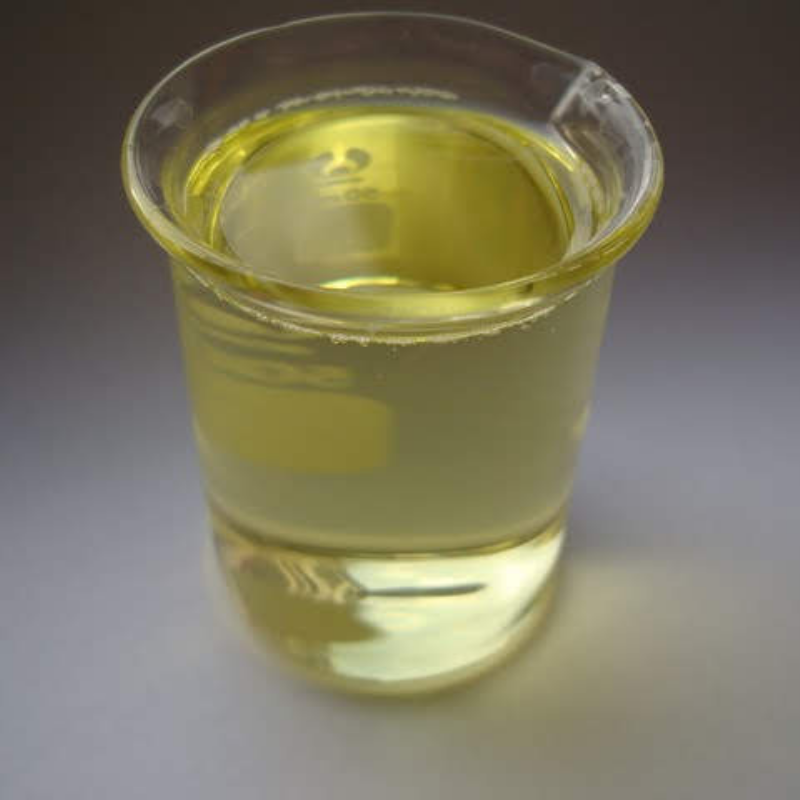
| exterior condition | A transparent liquid ranging in color from light brown to brown |
| pH value | 5.0-8.0 |
| Emulsion Stability | Diluted 200 times to meet FAO standards |
| Packaging specification | 90g × 40 bottles/case, 200g × 20 bottles/case, 450g × 20 bottles/case, 500mL × 20 bottles/case, 5L × 4 buckets/box |
| date of use (on foodstuffs) | 2 years |
Warm Tip: For specific application, please use under the guidance of local plant protection department and adjust the dosing program appropriately according to local weed communities, soil types and climatic conditions.

Reviews
There are no reviews yet.