
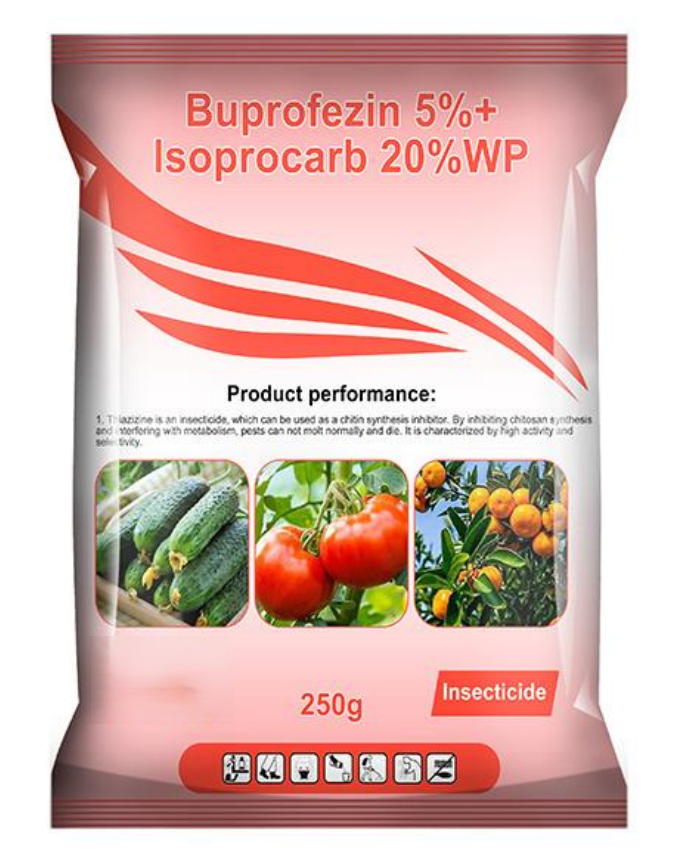
Description
Active Ingredients: Buprofezin 5% + Isoprocarb 20%
Product Overview
Thiazine·Isopropyl 25% Wettable Powder is a formulated insecticide that combines contact, stomach, and insect growth-regulating actions. It is primarily used to control sucking pests such as planthoppers and leafhoppers on rice, cotton, vegetables, and fruit trees. The product combines the long-lasting molting-inhibiting effect of thiazine with the rapid knockdown action of isopropyl, achieving the dual effect of “rapidly reducing pest populations + sustained control of nymphs.”
This product provides good overall control against pests such as the brown planthopper and is suitable for integrated pest management during the early stages of infestation and when pest densities are low to moderate.
Mechanism of Action of Active Ingredients
Mechanism of Action of Buprofezin
Thiazine belongs to the class of insect growth regulators (IGRs) and primarily acts by inhibiting chitin synthesis in pests. When pests come into contact with the pesticide, the nymphs are unable to molt normally and eventually die.
Key Features:
- Inhibiting Nymph Molting and Development
- Has a certain inhibitory effect on egg hatching
- Longer duration of effectiveness
- Has an inhibitory effect on the reproductive capacity of adult insects
- Relatively safe for natural enemies; suitable for Integrated Pest Management (IPM)
Thiazine is particularly effective against nymphs; while it takes relatively longer to take effect after application, it provides strong, long-lasting control.
Mechanism of Action of Isoprocarb
Isopropyl carbamate is a carbamate insecticide that acts as both a contact and stomach poison. It rapidly inhibits acetylcholinesterase activity in the nervous system of pests, disrupting neural transmission and causing rapid paralysis and death.
Key Features:
- Fast knockdown speed
- Effective against both adults and nymphs
- The contact-kill effect is significant
- Suitable for use during the rapid outbreak phase of insect infestations
Product Features
1. Combines fast-acting and long-lasting effects
Isopropyl quickly knocks down adult insects, rapidly reducing pest populations in the field; thiazine continuously inhibits nymph development, reducing the formation of subsequent pest populations.
2. Dual mechanism of action, delaying the development of resistance
Combining two agents with different mechanisms of action can reduce the risk of resistance associated with long-term use of a single agent, making them suitable for rotation in resistance management strategies.
3. Exceptional efficacy against leafhoppers and similar pests
It is effective against the following pests:
- Rice Planthopper
- White-backed Planthopper
- Brown Planthopper
- Leafhopper Pests
- Selected Whitefly Pests
4. Longer shelf life
After application, the product provides sustained control of nymph populations, reduces the number of repeat applications, and improves control efficiency.
5. Tailor Comprehensive Plant Protection Solutions
It is suitable for use in rotation with products that have different modes of action and can be integrated into green pest control and Integrated Pest Management (IPM) systems.
Dosage
Control of Rice Planthoppers
Recommended Dosage
- Amount of product to use per mu: 30–40 grams
- Water volume: 30–45 kilograms for even spraying
Application period
It is recommended to apply the pesticide during the early nymphal stages of aphids or at the onset of infestation to achieve the best control results.
Control of Leafhopper Pests
Recommended Dosage
- Amount of product to use per mu: 25–35 grams
- Uniform Spray Application
When pest populations are high, you may increase the application rate appropriately, and be sure to spray evenly to cover both sides of the leaves.
Guidelines for use
1. Pay attention to the optimal application time
Thiazine is most effective against nymphs; therefore, it is recommended to apply the pesticide during the peak period of early-instar nymphs to enhance overall control efficacy.
2. Spray evenly to improve coverage
Rice planthoppers and leafhoppers are mostly concentrated in the middle and lower parts of the plant; when applying pesticide, focus on spraying the base of the rice plants and the undersides of the leaves to ensure even coverage.
3. It is recommended to rotate medications
To delay the development of resistance, it is recommended to rotate use with the following agents that have different mechanisms of action:
- Neonicotinoid insecticides
- Bisamide-based agents
- Pyrimidinone-based products
- Trifluoropyrimidine Products
4. Avoid applying pesticides during periods of high temperatures
It is recommended to apply the pesticide before 10:00 a.m. or after 4:00 p.m. to avoid high temperatures causing evaporation that could reduce its effectiveness.
5. Safety Recommendations
- Wear protective gear when mixing and applying pesticides
- Avoid contact with skin and eyes
- Avoid contaminating water sources and aquaculture areas
- Clean the sprayer promptly after use.
Applicable crops
- maize
- wool
- Vegetables
- Fruit Trees
Storage and Transportation
- Store in a cool, dry, well-ventilated place
- Avoid direct sunlight and high temperatures
- Keep away from food, animal feed, and children
Protect against moisture and damage during transport

Reviews
There are no reviews yet.