
Description
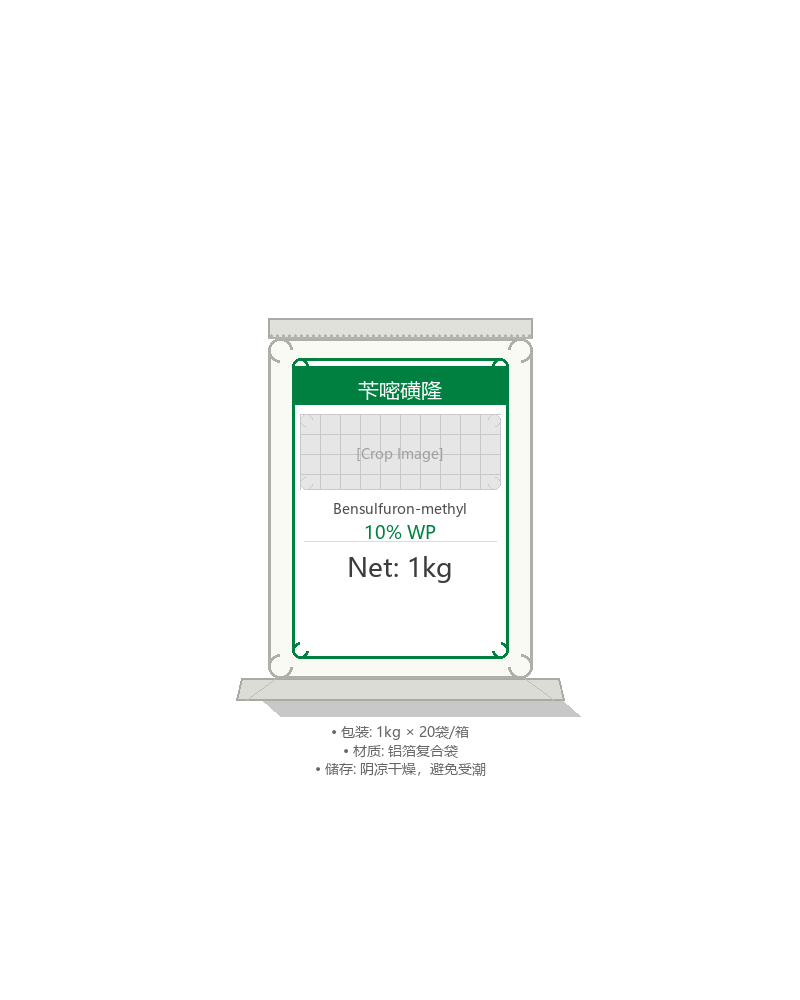
Bensulfuron 10% WP
Bensulfuron-methyl 10% WP
Pesticide Category: Herbicides Dosage form: Wettable Powder (WP) | Toxicity: lower toxicity
CAS number: 83055-99-6 | Chemical Name: Methyl 2-{[(4,6-dimethoxypyrimidin-2-yl)carbamoyl]aminosulfonylmethyl}benzoate
CAS number: 83055-99-6 | Chemical Name: Methyl 2-{[(4,6-dimethoxypyrimidin-2-yl)carbamoyl]aminosulfonylmethyl}benzoate
I. Product Profile
Benzylsulfuron 10% Wettable Powder is aClassic Selective Systemic Herbicides for Rice Fields, a sulfonylurea herbicide. The active ingredient in this product rapidly disperses in water, is absorbed by weed roots and leaves, and is transported to various parts of the plant, where it inhibits the biosynthesis of branched-chain amino acids and blocks cell division and growth. It provides excellent control of annual and perennial broadleaf weeds and Cyperaceae weeds in rice fields. As a staple product for controlling broadleaf and Cyperaceae weeds in rice fields, it offers stable efficacy, high safety, a long history of use, and widely verified results.
II. Mechanisms of action of active ingredients
Target: Acetyl-L-lactate synthase (ALS) inhibitor
Benzylsulfuron belongs toHRAC Class B / WSSA Class 2Herbicides with a mechanism of action:
forms
| active link | Specific mechanisms |
|---|---|
| absorption pathway | The active ingredient rapidly disperses in water and is absorbed by weedsRoot and Leaf Uptakeand then transferred to various locations |
| biochemical target | Inhibiting the activity of acetyl-L-lactate synthase (ALS), inhibiting the biosynthesis of branched-chain amino acids (valine, leucine, and isoleucine) |
| physiological effect | Inhibits cell division and growth, stunting weed growth and causing them to die |
| final performance | The tender tissues of sensitive weeds turn yellow prematurely, inhibiting leaf growth and hindering root development, ultimately leading to necrosis. |
selectivity principle (physics)
-
Rice can break down this pesticide, which has virtually no effect on rice growth; it is highly stable and safe.
-
It has low mobility in the soil, and temperature and soil type have little effect on its weed-control efficacy.
-
Shelf life25–35 days, and it is also safe for subsequent crops
III. Product characteristics
✅ Six Core Advantages
forms
| Specificities | particular |
|---|---|
| 🎯 Specialized in Kosa, with a wide range of target plants | It provides excellent control of annual and perennial broadleaf weeds and sedge weeds, and is particularly effective against knotweed and cowhage. |
| 🔄 Systemic action, thoroughly eradicates | Once absorbed by the roots and leaves of the weeds, it is transported throughout the plant, destroying it from the inside out, with no regrowth |
| ⏱️ Long-lasting, one application lasts | Effective for 25–35 days; a single application is sufficient to control weeds during the seedling stage of rice. |
| 🛡️ Safe for rice, suitable for subsequent crops | Safe for rice, leaves no soil residues, and is also safe for subsequent crops |
| 💧 Flexible and versatile | Can be broadcast or mixed with water for spraying; suitable for application both before and after seedling emergence |
| 🌾 Classic formula, consistent results | The 10% classic formulation has a long history of use, and its effectiveness has been widely proven. |
🎯 Preventing Objects
Primary prevention and eradication: Duckbill grass, water milfoil, jointed waterweed, cowhair rush, heteromorphic sedge, water sedge, broken-grain sedge, water-snake grass, water amaranth, field mustard, Alisma, rainflower, dwarf arrowhead (at high doses), and other annual and perennial broadleaf weeds and sedge weeds.
Ineffective against the following weeds: Grass weeds such as barnyard grass and foxtail (which are only suppressed at high doses).
Suitable crops: Rice seedling beds, direct-seeded rice fields, and transplanted rice fields.
IV. Usage and dosage
📋 Rice field use program
forms
| Crop type | Application period | Dosage (formulated dose/acre) | water consumption | Mode of application |
|---|---|---|---|---|
| Rice seedling beds/direct-seeding fields | From sowing until the two-leaf stage of weeds | 20–30 grams per mu | 30 kilograms per mu | Spray or mix with 20 kilograms of fine, moist soil and broadcast it |
| Rice transplanting field | 5–7 days after transplanting (optimal) | 20–30 grams per mu | 30 kilograms per mu | Spraying or broadcasting with fine soil |
| Rice Transplanting Field (Perennial Weeds) | 5–7 days after transplanting | 30–50 grams per mu | 30 kilograms per mu | Spraying or broadcasting with fine soil |
📋 Application Guidelines for Wheat Fields
forms
| Crop type | Application period | Dosage (formulated dose/acre) | water consumption | Mode of application |
|---|---|---|---|---|
| Wheat field | When weeds have 2–3 leaves and the soil is moist | 30–40 grams per mu | 30 kilograms per mu | Foliar spray |
Active ingredient dosage: The active ingredient dosage per mu for 10% benzylpyrimidesulfonate is 2–5 grams per muIt is effective against weeds in the two-leaf stage or earlier, but less effective against those past the three-leaf stage.
V. Guidance for use
🔧 Application Points
forms
| move | operational specification |
|---|---|
| 1. Field preparation | Level the field and maintain a water depth of 3–5 centimeters. |
| 2. Aquifer management | Maintain a water depth of 3–5 cm during application, and keep the field moist for 3–4 days (direct-seeding fields) or 3–5 days (transplanted fields) after application. |
| 3. Dispensing methods | Using the two-step dilution method, first thoroughly disperse the chemical in a small amount of water, then add sufficient water. |
| 4. Poisonous soil method | Mix the formulation with 20 kilograms of fine, moist soil per mu, and apply evenly after the morning dew has dried. |
| 5. Spraying | Mix 30 kilograms per mu with water and spray evenly to ensure complete coverage of the weeds. |
⚠️ Key Considerations
-
⏰ Optimal application period: 对Weeds with two or fewer leavesIt is most effective before the three-leaf stage; effectiveness decreases after that. In transplanted fields, it is best to apply the pesticide 5–7 days after transplanting.
-
🚫 Contraindications: 以This product should not be used in rice paddies where barnyard grass is the dominant weed.; It is relatively sensitive to late-season rice varieties (japonica and glutinous rice), so application during the budding stage of late-season rice should be avoided as much as possible, as it may otherwise cause phytotoxicity.
-
💧 Water Management: When applying the pesticide, the rice field must haveWater depth: 3–5 cm, to ensure even distribution of the pesticide; do not drain or flush the area for 7 days after application to avoid reducing the pesticide’s effectiveness.
-
🌡️ Temperature effects: Temperature and soil type have little effect on weed control, but the herbicide has low mobility in the soil.
-
🐟 Aquatic safety: It is low in toxicity to fish, birds, and bees, but caution is still advised in rice paddies where fish are raised.
-
🧪 Blending recommendations: can be used withazoxystrobinWhen used in combination, it quickly controls broadleaf weeds in wheat fields, offers a broad spectrum of weed control, delivers excellent results, and effectively prevents weed regrowth.
-
🔄 Resistance management: Long-term single use is prone to resistance, it is recommended to combine withDichloroquinoline acid, propachlorRotate or mix herbicides with different modes of action.
-
🛡️ security: Wear protective clothing, gloves, and a mask when applying the pesticide; wash your hands and face immediately after application; pregnant and breastfeeding women should avoid contact.
-
🧹 Instrument cleaning: Rinse the sprayer thoroughly after use to prevent residual pesticide from causing phytotoxicity to other crops.
-
📦 Storage conditions: Store in a cool, dry, well-ventilated place, away from direct sunlight and high temperatures; keep away from sources of fire and out of the reach of children.
Sixth, product specifications and packaging
forms
| sports event | parameters |
|---|---|
| Active ingredient content | Benzylsulfuron ≥10% |
| exterior condition | White to pale yellow powder |
| Suspension rate | ≥70% |
| Wetting time | ≤120 seconds |
| Packaging specification | 10 g × 200 bags per case, 20 g × 200 bags per case, 30 g × 100 bags per case, 50 g × 100 bags per case |
| date of use (on foodstuffs) | 2 years |
Warm Tip: When applying this product, please follow the guidance of your local plant protection authorities and adjust the application plan as appropriate based on local weed communities, cultivation practices, and climatic conditions.

Reviews
There are no reviews yet.