
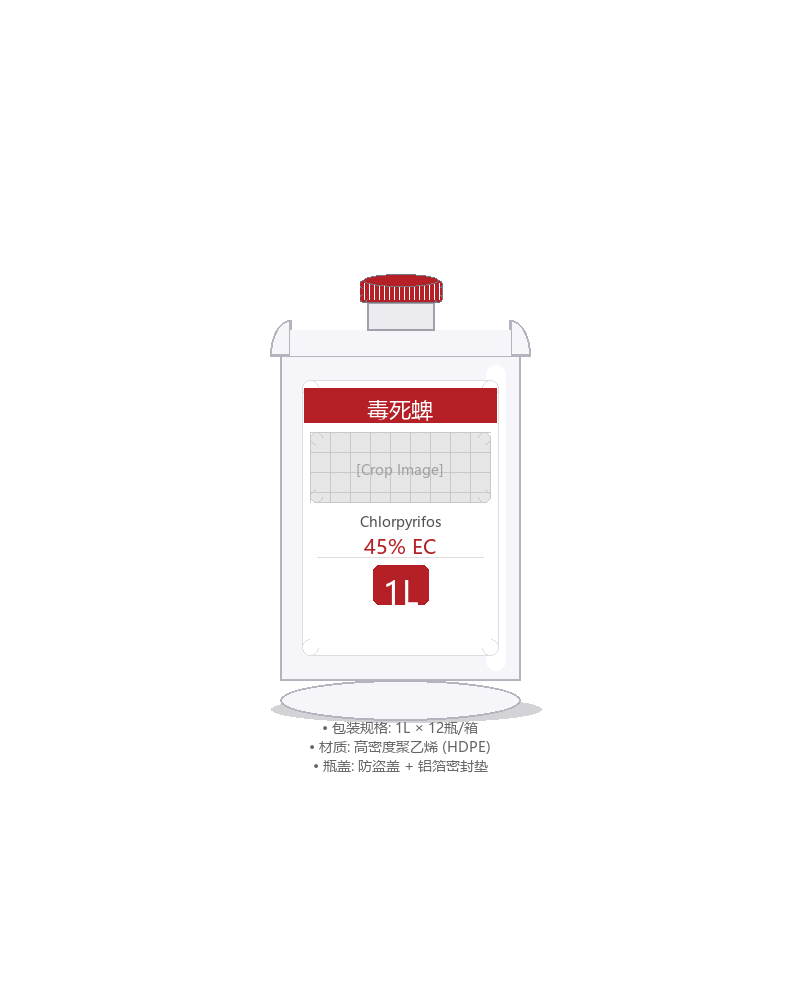
Chlorpyrifos 45% emulsifiable concentrate
$0.00
chlorpyrifos (chlorpyrifos)
Out of stock
Find more products
Description
Diethylammonium chloride
Chlorpyrifos 45% EC
Mechanism of action of the active ingredient
Chlorpyrifos genusThiophosphatesOrganophosphate insecticides work by inhibiting the action ofAcetylcholinesterase (AChE)It acts by disrupting the normal transmission of nerve impulses, causing the pests to become paralyzed and die. It hasTouch, stomach and fumigationWith its triple mode of action, it offers an extremely broad spectrum of insecticidal activity. The high-concentration formulation of 45% reduces the amount of product required per unit area while maintaining the same level of efficacy, thereby lowering transportation and storage costs. It is particularly well-suited for large-scale aerial application and professional integrated pest management.
Product Features
forms
| Specificities | Instructions |
|---|---|
| High Concentration, Less Product Needed | The 45% high-concentration formulation requires approximately 10% less product per unit area than the 40% formulation, thereby reducing application costs. |
| Triple Broad-Spectrum | Contact, stomach, and fumigation action provide excellent control against both above-ground and below-ground pests, as well as mites. |
| Fast-acting and long-lasting | Takes effect quickly upon contact with the pest; remains effective on leaves for 5–7 days and in the soil for an even longer period |
| Highly permeable | It penetrates the cuticle of leaves and the body walls of insects, thoroughly eliminating hidden pests such as leaf-rolling and leaf-mining insects. |
| Flexible Applications | Suitable for various application methods, including spraying, root drenching, and soil treatment |
Dosage
forms
| Applicable crops | prevention and treatment target | Preparation dosage | dilution factor | Application method |
|---|---|---|---|---|
| maize | Second-generation armyworm, third-generation armyworm | 65–80 mL per mu | 1000-1500 times | mist evenly |
| maize | Rice leaf roller, rice planthopper | 60–80 mL per mu | 1000-1500 times | mist evenly |
| Wheat | greenfly (Aphis spp.) | 30–40 mL per mu | 1500-2000 times | mist evenly |
| wool | greenfly (Aphis spp.) | 100–125 mL per mu | 1000-1500 times | mist evenly |
| apple tree | pink heartworm | 2,133–2,667 times | — | mist evenly |
| apple tree | Cotton Aphid | 1,600–2,133 times | — | mist evenly |
| citrus tree | Arrowhead Scale | 800–1,600 times | — | mist evenly |
Guidelines for use
-
Optimal application period: Apply pesticides to cutworms during the peak period of the 1st–2nd instar larvae; apply pesticides to aphids at the onset of their peak population; apply pesticides to scale insects during the peak period of early-instar larvae.
-
Spraying Points: When applying pesticides to rice, maintain a shallow layer of water in the field; when spraying fruit trees, ensure the spray covers the fruit and new shoots; when spraying wheat, ensure the spray evenly covers the base of the stems and the leaves.
-
mixing taboo:Do not mix with alkaline pesticides; When formulated with high-efficacy cyhalothrin, it significantly extends the residual efficacy and broadens the spectrum of insecticidal activity.
-
safety interval: Rice: 15 days (up to 2 applications per season); Citrus: 28 days (up to 1 application per season); Apple: 30 days (up to 1 application per season); Wheat: 14 days (up to 1 application per season); Cotton: 21 days.
-
environmental safety: Toxic to bees, fish, and silkworms; do not use near nectar-producing crops during their flowering period, in silkworm rearing rooms, in mulberry groves, or near aquaculture areas; do not wash application equipment in water bodies such as rivers and ponds.

Reviews
There are no reviews yet.