
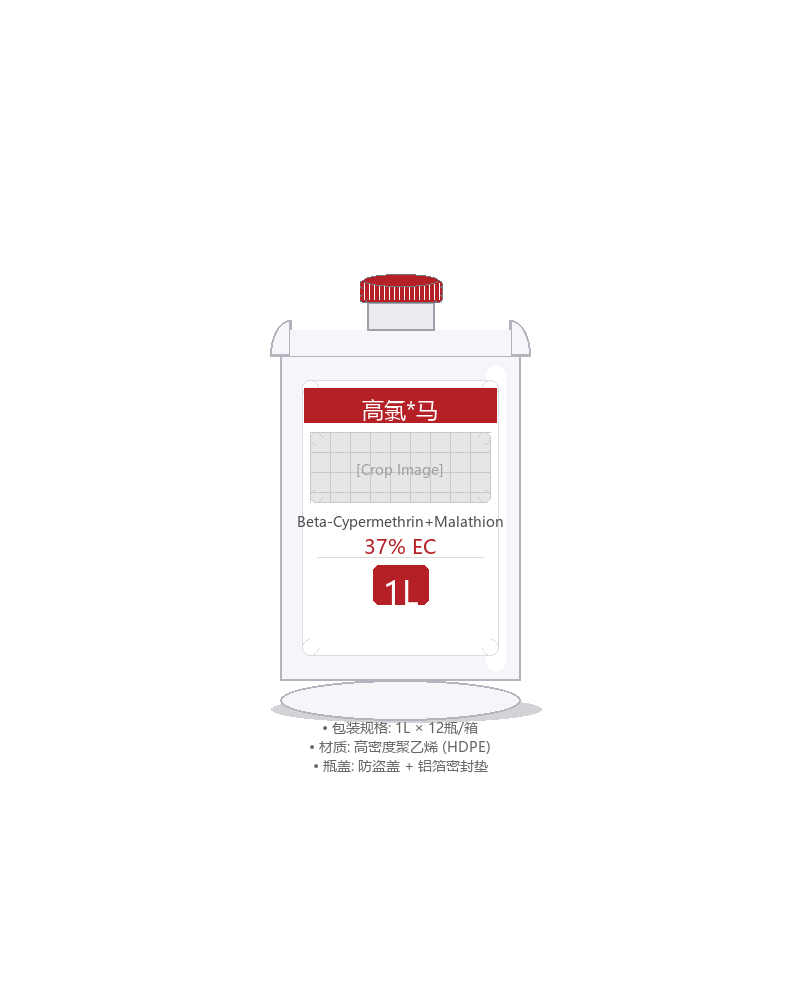
Perchlor*ma 37% emulsifiable concentrate
$0.00
Perchlor*ma
Out of stock
Find more products
Description
Diethylammonium chloride
Perchloro-Mar 37% emulsifiable concentrate
Beta-Cypermethrin - Malathion 37% EC
(Cypermethrin 0.8% + Malathion 36.2%)
Beta-Cypermethrin - Malathion 37% EC
(Cypermethrin 0.8% + Malathion 36.2%)
Mechanism of action of the active ingredient
this product isPyrethroids and organophosphatesScientific compounding of preparations, dual-mechanism synergistic effect:
-
Malathion (organophosphorus): Suppresses the nervous system of pestsAcetylcholinesterase (AChE)activity, interfering with nerve signaling;
-
Cypermethrin (Permethrin): Selective action on pest neural axonsVoltage-gated sodium channels, resulting in nerve paralysis.
The dual-target action can simultaneously block the generation and transmission of nerve impulses of pests, significantly expanding the insecticide spectrum and effectively delaying the development of resistance. BothGastric toxicity, poisoning by touch and some fumigating effectsIt has been shown to maintain excellent efficacy against pest populations that are already resistant.
Product Features
forms
| Specificities | Instructions |
|---|---|
| Dual mechanism synergies | Permethrin + organophosphorus double target action, significant efficiency, antagonistic populations to enhance the efficacy of more than 30% |
| Resistance management | Effectively overcome the single use of pyrethroids or organophosphorus resistance, prolong the service life of the agent |
| broad-spectrum and rapid-acting | Highly effective against Lepidoptera, Homoptera, and Hemiptera pests, with fast knockdown and 24-hour mortality rate of over 90% |
| long-lasting | After compounding, the duration of efficacy is extended to 7-10 days, which is significantly higher than that of single agent malathion (3-5 days). |
| Low cost and high efficiency | Malathion has a clear cost advantage, combining cost-effectiveness with high performance when formulated. |
Dosage
forms
| Applicable crops | prevention and treatment target | Preparation dosage | dilution factor | Application method |
|---|---|---|---|---|
| wool | cotton bollworm | 100-120 mL/mu | 1000-1500 times | mist evenly |
| wool | cotton aphid | 20-40 mL/mu | 1500-2000 times | mist evenly |
| Kale/Cabbage | cabbage greenfly | 32-64 mL/mu | 1500-2000 times | mist evenly |
| gai larn | Chinese white moth (Bombyx mori) | 30-60 mL/mu | 1500-2000 times | mist evenly |
| apple tree | pink heartworm | 1000-2000 times | — | mist evenly |
| apple tree | yellow aphis (Aphis spp.) | 2000-3000 times | — | mist evenly |
| citrus tree | greenfly (Aphis spp.) | 2000-4000 times | — | mist evenly |
| Lychee/Longan | bedbug | 2000-3000 times | — | mist evenly |
Guidelines for use
-
Optimal application periodApply to cotton bollworms from the egg hatching stage to the lower larval stage; to cabbage greenfly at the 1-2 larval stage; and to fruit tree pests at the beginning of the pest season.
-
Spraying PointsVegetable spraying should cover the front and back of the leaves and the heart of the vegetable; fruit tree spraying should cover the leaf surface and the back of the leaf uniformly; spraying with the wind to avoid drifting.
-
mixing taboo:Do not mix with alkaline pesticides; can be rotated with neonicotinoids, benzoylureas, and other agents with different mechanisms of action.
-
Limitations on use: Toxic to bees, silkworms and fish, apply far away from the flowering period of honey plants, silkworm rooms and aquaculture areas.
-
safety interval: 10 days for kale (up to 2 times per season), 21 days for citrus (up to 3 times per season), and 7 days for cotton.
-
resistance strategy: It is recommended to alternate with agents without cross-resistance such as high-performance cypermethrin, acetamiprid and flufenoxuron, and to avoid using them for more than 2 seasons in a row.

Reviews
There are no reviews yet.