
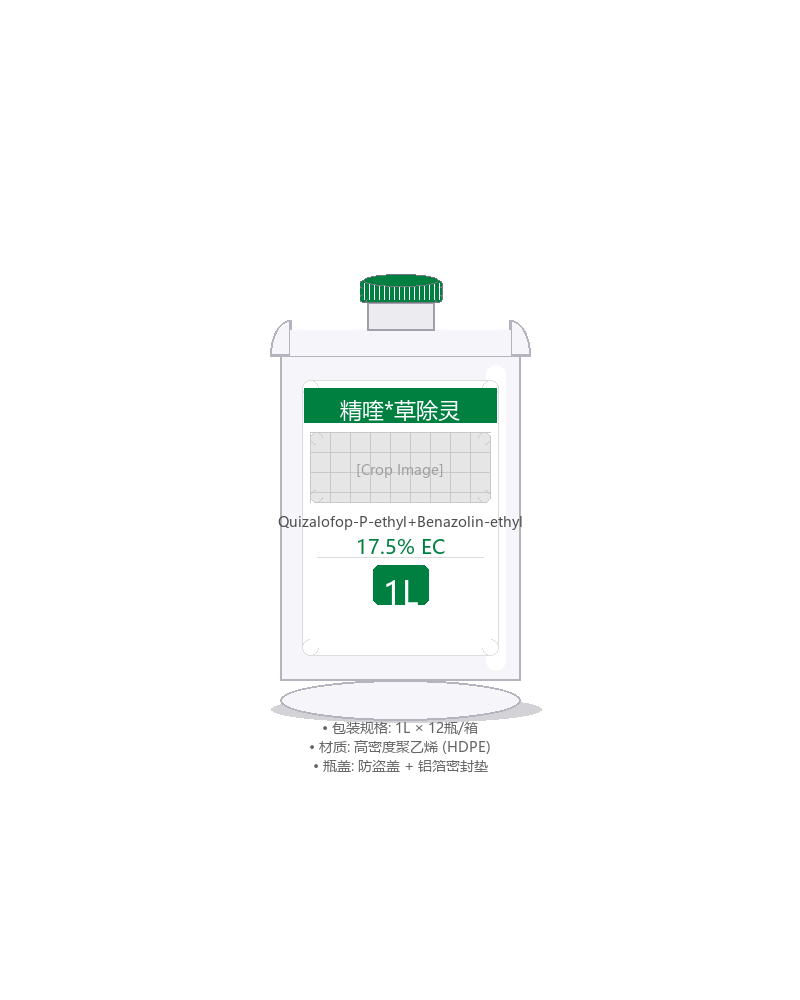
Description
Jingquing·Caochuling 17.5% Emulsifiable Concentrate
Quizalofop-P-ethyl + Benazolin-ethyl 17.5% EC
Pesticide Category: Herbicides Dosage form: Emulsifiable concentrates (EC)| Toxicity: lower toxicity
Active ingredients: Quinclorac 2.5% + Chlormequat 15% | Total active ingredient content: 17.5%
Active ingredients: Quinclorac 2.5% + Chlormequat 15% | Total active ingredient content: 17.5%
I. Product Profile
Jingquing·Caochuling 17.5% emulsifiable concentrate is aBinary Selective Post-Emergence Foliar Herbicide, byA selective herbicide for grass weeds in the furoxyphenoxypropanoic acid class (quinclorac)andHormone-based broadleaf weed herbicide (Grass Killer)Scientifically formulated. Designed specifically for rapeseed fields, this product offers dual action against both broadleaf and grass weeds. It provides excellent control of most annual broadleaf and grass weeds in rapeseed fields, making it a highly effective solution for integrated weed management in rapeseed fields.
II. Mechanisms of action of active ingredients
Mechanism of dual-target synergy
forms
| Ingredients | Function Category | mechanism of action | Mechanism of action |
|---|---|---|---|
| quinquefoil (antifungal agent) | HRAC Class A / WSSA Class 1 | Acetyl-CoA carboxylase (ACCase) inhibitors, inhibits fatty acid synthesis | Absorbed by the stems and leaves, then transported in both directions to the growing points |
| Weed Killer | HRAC Class O / WSSA Class 4 | Synthetic hormones, interfering with nucleic acid metabolism and protein synthesis | Absorbed by the stems and leaves and transported throughout the plant |
The Principle of Synergy
-
Grass-Specific Herbicide (Quinclorac): After absorption through the stems and leaves, the active ingredient is transported in both directions, inhibiting ACCase activity and blocking fatty acid synthesis. This causes necrosis of the weed’s growing point, halting growth within 3 days and resulting in browning and death of the base within 7 days. It is highly effective against grass weeds such as wild oats and wild barley.
-
Broadleaf Weed Control (Grass Eliminator): As a synthetic hormonal herbicide, it is absorbed by weeds and interferes with nucleic acid metabolism and protein synthesis, causing the weeds to become deformed, twisted, and yellowed, eventually leading to their death. It is highly effective against broadleaf weeds such as pigweed, chickweed, and cow parsley.
-
Synergy: Jingquinhuiling addresses the shortcoming of Caochuling, which is ineffective against grass weeds; Caochuling addresses the shortcoming of Jingquinhuiling, which is ineffective against broadleaf weeds, thereby achieving the simultaneous control of both grass and broadleaf weeds in rapeseed fields.
III. Product characteristics
✅ Six Core Advantages
forms
| Specificities | particular |
|---|---|
| 🎯 HeKuo Dual Control: One Product, Multiple Benefits | Controls both grass and broadleaf weeds simultaneously, reducing the number of applications and saving labor and time |
| 🔄 Systemic action, thoroughly eradicates | Both active ingredients are systemic, destroying weeds from within and preventing regrowth. |
| ⏱️ Consistent results, minimally affected by environmental factors | The product works quickly in high temperatures and more slowly in low temperatures, but its overall efficacy remains consistent. |
| 🛡️ Specifically designed for rapeseed; highly safe | Safe for Brassica napus at the recommended dose; rapidly degrades in soil |
| 💧 Synergies, Cost Reduction, and Quality Improvement | Dual-target action reduces the risk of resistance and enhances overall control efficacy |
| 🌾 Broad-spectrum weed control, covering major weeds | It provides effective control of the major annual weeds in rapeseed fields |
🎯 Preventing Objects
Grass weeds: See wheatgrass, wild oats, crabgrass, foxtail, and bentgrass, among others.
Broadleaf weeds: Pigweed, chickweed, cow parsley, goosefoot, wild rapeseed, shepherd's purse, veronica, etc.
Suitable crops: Winter rapeseed fields (cabbage-type rapeseed).
IV. Usage and dosage
📋 Application Guidelines for Rapeseed Fields
forms
| Crop type | Application period | Dosage (formulated dose/acre) | water consumption | Mode of application |
|---|---|---|---|---|
| Field for transplanting winter rapeseed | After transplanting and establishment, when weeds have 3–5 leaves | 100-150 ml/acre | 30-40 kg/mu | Foliar spray |
| Fields of direct-seeded winter rapeseed | 5–6-leaf stage; weeds at the 3–5-leaf stage | 100-150 ml/acre | 30-40 kg/mu | Foliar spray |
Dosage Instructions: Use the upper limit when weed density is high and weeds are mature; use the lower limit when weed density is low and weeds are young. The application rate of active ingredient per mu is 26.3–39.4 grams per mu。
V. Guidance for use
🔧 Application Points
forms
| move | operational specification |
|---|---|
| 1. Determine the age of the grass | Among the weeds3–5-leaf stageFor best results, apply the herbicide when the weeds are as young as possible. |
| 2. Select Weather | Apply the pesticide on windless or light-wind days to prevent drift. |
| 3. Spray method | Aim the spray at the stems and leaves of the weeds to ensure that the entire plant is covered with the herbicide. |
| 4. Water consumption | Mix 30–40 kilograms per mu with water, ensuring thorough and even application. |
| 5. Application timing | It is best toIn the eveningUse during periods when temperatures are not high |
⚠️ Key Considerations
-
⏰ Optimal application period: Weeds3–5-leaf stageTo ensure optimal application, increase the dosage or apply in multiple treatments when the weeds have reached the 5-leaf stage or beyond.
-
🚫 Types of rapeseed to avoid: Brassica napus is highly sensitive and should not be used; Chinese cabbage-type rapeseed has shown mild pesticide damage; the application should be postponed accordingly.
-
🌡️ Temperature effects: Do not apply the pesticide in hot weather; it is best to apply it in the evening. The product works faster in high temperatures and slower in low temperatures.
-
💧 Impact of soil moisture conditions: When soil moisture is high and temperatures are warm, the pesticide takes effect quickly and effectively; when soil moisture is low and temperatures are cool, the pesticide takes longer to take effect.
-
🌿 Spray quality: To prevent the rapeseed leaves from blocking the spray, be sure to apply the herbicide directly to the weeds.
-
🧪 Mixing Taboo: Do not mix with alkaline pesticides; avoid excessive mixing with hormonal herbicides.
-
🔄 Number of uses: Use no more than1 time。
-
🐟 Aquatic safety: Apply the pesticide away from aquaculture areas; do not wash application equipment in water bodies such as rivers or ponds.
-
🛡️ security: When applying pesticides, wear long sleeves and long pants, gloves, and goggles; do not smoke or drink water while applying pesticides; wash your hands and face thoroughly after application.
-
📦 Storage conditions: Store in a cool, dry, well-ventilated place, away from direct sunlight and high temperatures; keep away from sources of fire and out of the reach of children.
Sixth, product specifications and packaging
forms
| sports event | parameters |
|---|---|
| Total active ingredient content | 17.5% (Quinclorac 2.5% + Clodinafop-propargyl 15%) |
| exterior condition | Brownish yellow transparent liquid |
| pH value | 5.0-8.0 |
| Emulsion Stability | Diluted 200 times to meet FAO standards |
| Packaging specification | 90 mL × 40 bottles/case, 100 mL × 50 bottles/case, 200 mL × 40 bottles/case, 500 mL × 20 bottles/case |
| date of use (on foodstuffs) | 2 years |
Warm Tip: When applying this product, please follow the guidance of your local plant protection authorities and adjust the application plan as appropriate based on local weed communities, rapeseed varieties, and climatic conditions.

Reviews
There are no reviews yet.