
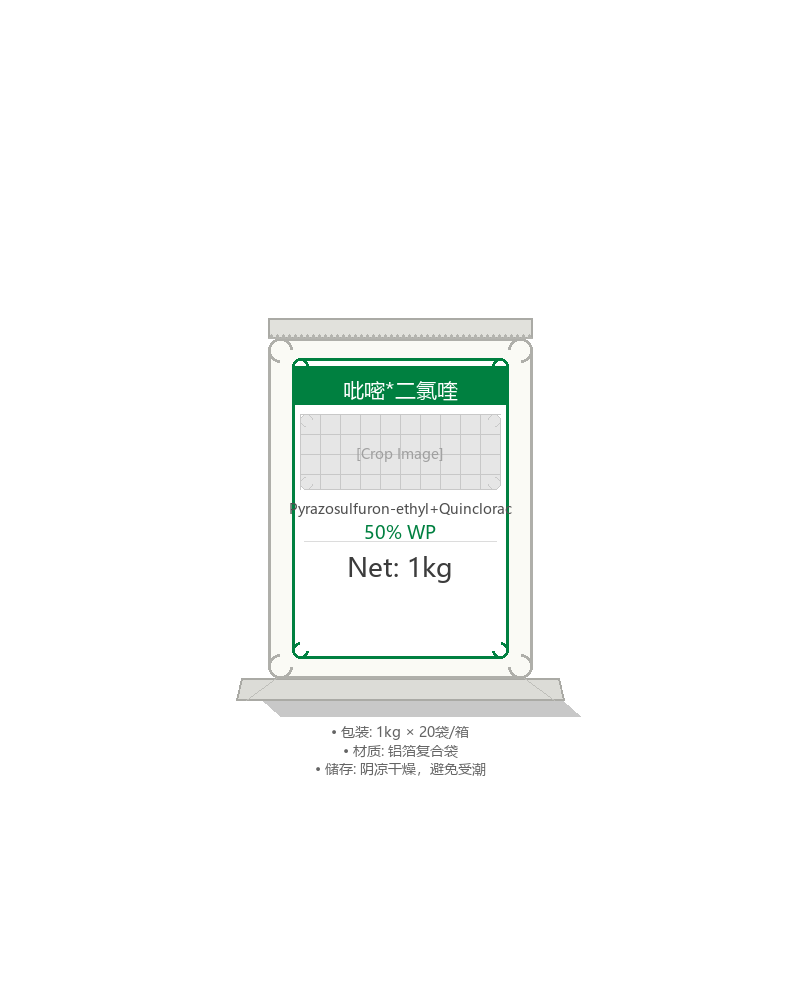
Pyrimethamine* dichloroquine 50% wettable powder
$0.00
Pyrimidine* dichloroquine
Out of stock
Find more products
Description
Pyrimidine·Dichloroquin 50% Wettable Powder
Pyrazosulfuron-ethyl + Quinclorac 50% WP
Pesticide Category: Herbicides Dosage form: Wettable Powder (WP) | Toxicity: lower toxicity
Active ingredients: Pyrimidylsulfuron + Dichloroquinoline Acid | Total active ingredient content: 50%
Active ingredients: Pyrimidylsulfuron + Dichloroquinoline Acid | Total active ingredient content: 50%
I. Product Profile
Pyrimidine·Dichloroquin 50% Wettable Powder is aBinary Formulation Herbicide Specifically Designed for Rice Fields, bySulfonylurea Herbicide for Broadleaf Cyperus (Pyrimidylsulfuron)andQuinoline carboxylic acid-based weed herbicide (dichloroquinoline carboxylic acid)Scientifically formulated. This product offers dual efficacy against barnyard grass and broadleaf weeds, as well as sedges, and provides excellent control against the major weed types found in rice fields—barnyard grass, broadleaf weeds, and sedges—making it a highly effective solution for integrated weed management in rice fields.
II. Mechanisms of action of active ingredients
Mechanism of dual-target synergy
forms
| Ingredients | Function Category | mechanism of action | Mechanism of action |
|---|---|---|---|
| Pyrazosulfuron | HRAC Class B / WSSA Class 2 | Acetyl-L-lactate synthase (ALS) inhibitors, inhibiting the synthesis of branched-chain amino acids | Systemic; absorbed primarily through the root system |
| dichloroquinolinic acid | HRAC Class O / WSSA Class 19 | Synthetic hormone inhibitors, disrupting auxin metabolism | Systemic; absorbed by roots and leaves and transported upward |
The Principle of Synergy
-
Broadleaf Cyperus Herbicide (Pyrimidylsulfuron): It is primarily absorbed through the root system, rapidly translocates within the weed plant, inhibits ALS enzyme activity, and blocks the synthesis of branched-chain amino acids, causing the weed to gradually die. It provides excellent control against annual and perennial broadleaf weeds and Cyperaceae weeds, including common sedge, water sedge, water arrowhead, duckweed, water celery, water purslane, wild arrowhead, water milfoil, duckweed, and water hyssop.
-
Weed Killer (Dichloroquinoline Acid): It is rapidly absorbed by the seeds, roots, and leaves of emerging weeds, primarily through the roots. After absorption, it is transported within the plant to the apical meristems and stems, where it primarily inhibits the growth points of barnyard grass, ultimately causing the leaves to droop, wilt, and die. It is highly effective against barnyard grass (Oryza sativa) and common barnyard grass (Echinochloa crus-galli) in the 1–7-leaf stage.
-
Synergy: Pyrimidylsulfuron compensates for dichloroquinoline acid’s poor efficacy against broadleaf weeds and sedge weeds; Dichloroquinoline acid compensates for pyrimidylsulfuron’s limited effectiveness against barnyard grass and Echinochloa crus-galli, thereby achieving complete control of grass, broadleaf, and sedge weeds in rice fields.
III. Product characteristics
✅ Six Core Advantages
forms
| Specificities | particular |
|---|---|
| 🎯 Hekuosha: Total Control—One Product, Multiple Effects | Simultaneously controls barnyard grass, broadleaf weeds, and sedge weeds, covering the major weeds found in rice fields |
| 🔄 Systemic action, thoroughly eradicates | Both active ingredients are systemic, destroying weeds from within and preventing regrowth. |
| ⏱️ Effective against mature barnyard grass | Dichloroquinoline acid is effective against barnyard grass at all growth stages from 1 to 7 leaves, and has a wide application window. |
| 🛡️ Safe for rice, highly selective | It is safe for rice at the recommended dosage and does not affect tillering or yield. |
| 💧 Flexible and versatile | Can be sprayed or mixed with soil and broadcast; suitable for various cultivation methods, including transplanting and direct seeding |
| 🌾 Long-lasting, one application is all it takes | A single application of herbicide effectively controls weeds throughout the entire growth cycle of rice |
🎯 Preventing Objects
Primary prevention and eradication: Barnyard grass (1–7-leaf stage), water pennywort, heterophyllous sedge, water sedge, water caltrop, duckweed, water celery, jointed water plantain, wild arrowhead, water milfoil, duckweed, water-snakeweed, water dragon, water-melon-skin grass, bitter grass, and other annual and some perennial weeds.
Suitable crops: Rice transplanted fields, direct-seeded rice fields, and rice fields with scattered seedlings.
IV. Usage and dosage
📋 Rice field use program
forms
| Crop type | Application period | Dosage (formulated dose/acre) | water consumption | Mode of application |
|---|---|---|---|---|
| Rice transplanting field | 7–20 days after transplanting, when barnyard grass is in the 1–7-leaf stage | 40–60 grams per mu | 30-40 kg/mu | Foliar spray or broadcast application mixed with soil |
| Rice direct seeding field | After the 2.5-leaf stage of the seedlings | 40–60 grams per mu | 30-40 kg/mu | Foliar spray or broadcast application mixed with soil |
| Rice Fields with Transplanted Seedlings | 7–10 days after transplanting | 40–50 grams per mu | 30-40 kg/mu | Mix with soil and broadcast |
Active ingredient dosage: The recommended application rate of pyrimidylsulfuron per mu is 2–4 grams per mu, the dosage of the active ingredient in dichloroquinoline acid per mu is 20–30 grams per mu。
V. Guidance for use
🔧 Application Points
forms
| move | operational specification |
|---|---|
| 1. Determine the age of the grass | This product can be applied at any stage from 1 to 7 leaves on barnyard grass; however, the best control is achieved when applied at the 2- to 3-leaf stage. |
| 2. Drainage and Application of Pesticides | Drain the water from the field the day before applying the pesticide. |
| 3. Spray evenly | Mix 30–40 kilograms of the product per mu with water and spray evenly to ensure complete coverage of the weeds. |
| 4. Watering and Moisture Retention | Water the plants 1–2 days after application, and maintain a water depth of 3–5 centimeters for 5–7 days. |
| 5. Mix with soil and broadcast | Mix the formulation with 15–20 kilograms of fine soil per mu, and apply it evenly after the dew has dried. |
⚠️ Key Considerations
-
⏰ Optimal application period: Weeds2–3-leaf stageThis product is most effective when applied at this stage; it controls barnyard grass at the 1–7-leaf stage, but the application rate should be increased appropriately as the weeds grow older.
-
🚫 Pesticide damage to subsequent crops: High residue levels in the soil can easily cause phytotoxicity in subsequent crops; subsequent crops may include rice, corn, and sorghum, butSolanaceae (tobacco, potatoes, chili peppers, etc.), Apiaceae (carrots, celery), Amaranthaceae (spinach, sugar beet), Malvaceae, Cucurbitaceae (various melons and gourds), Fabaceae, Asteraceae, and Convolvulaceae crops are sensitive to this herbicide.。
-
💧 Water Management: Drain the water the day before application and apply a uniform spray. Irrigate 1–2 days after application and maintain a water depth of 3–5 centimeters for 5–7 days.
-
🌡️ Drift Risk: These crops (carrots, celery, cilantro, etc.) are quite sensitive to the Umbelliferae family; spray drift can easily cause phytotoxicity to these crops in adjacent fields, so spray drift should be avoided during application.
-
🐟 Aquatic safety: This product is non-toxic to fish and bees, but apply it away from aquaculture areas; do not wash application equipment in water bodies.
-
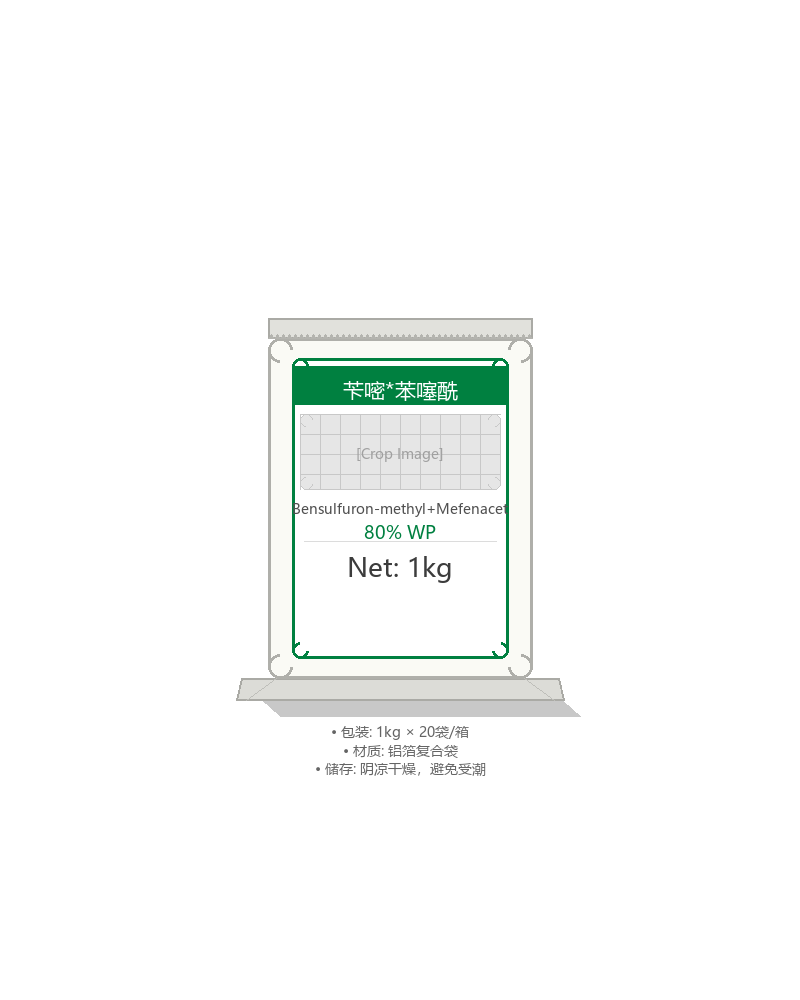
🧪 Blending recommendations: can be used withChlorimuron-ethyl, benzosulfuron-methyl, diquat, cyhalofop-butyl...are used in combination to broaden the spectrum of weeds controlled.
-
🔄 Resistance management: In some areas, dichlorquinoleic acid is frequently applied in excess, leading to cumulative herbicide damage in fields; it is recommended to rotate its use with herbicides that have different modes of action, and to apply it no more than once per season.
-
🛡️ security: Wear protective clothing, gloves, and a mask when applying the pesticide; wash your hands and face immediately after application; pregnant and breastfeeding women should avoid contact.
-
🧹 Instrument cleaning: Thoroughly clean the sprayer after use to prevent residual pesticide from causing phytotoxicity to subsequent sensitive crops.
-
📦 Storage conditions: Store in a cool, dry, well-ventilated place, away from direct sunlight and high temperatures; keep away from sources of fire and out of the reach of children.
Sixth, product specifications and packaging
forms
| sports event | parameters |
|---|---|
| Total active ingredient content | 50% (pyrimethanil + dichloroquinoline acid) |
| exterior condition | Grayish-white to pale yellow powder |
| Suspension rate | ≥70% |
| Wetting time | ≤120 seconds |
| Packaging specification | 25g × 200 bags/case, 50g × 100 bags/case, 100g × 50 bags/box, 500g × 20 bags/box |
| date of use (on foodstuffs) | 2 years |
Warm Tip: When applying this product, please follow the guidance of your local plant protection authorities and adjust the application plan as appropriate based on local weed communities, cultivation practices, and climatic conditions.

Reviews
There are no reviews yet.