
Pentaflumizone 5% dispersible oil suspension
$0.00
Pentaflumizone
Out of stock
Find more products
Description
Pentaflumizone 5% dispersible oil suspension
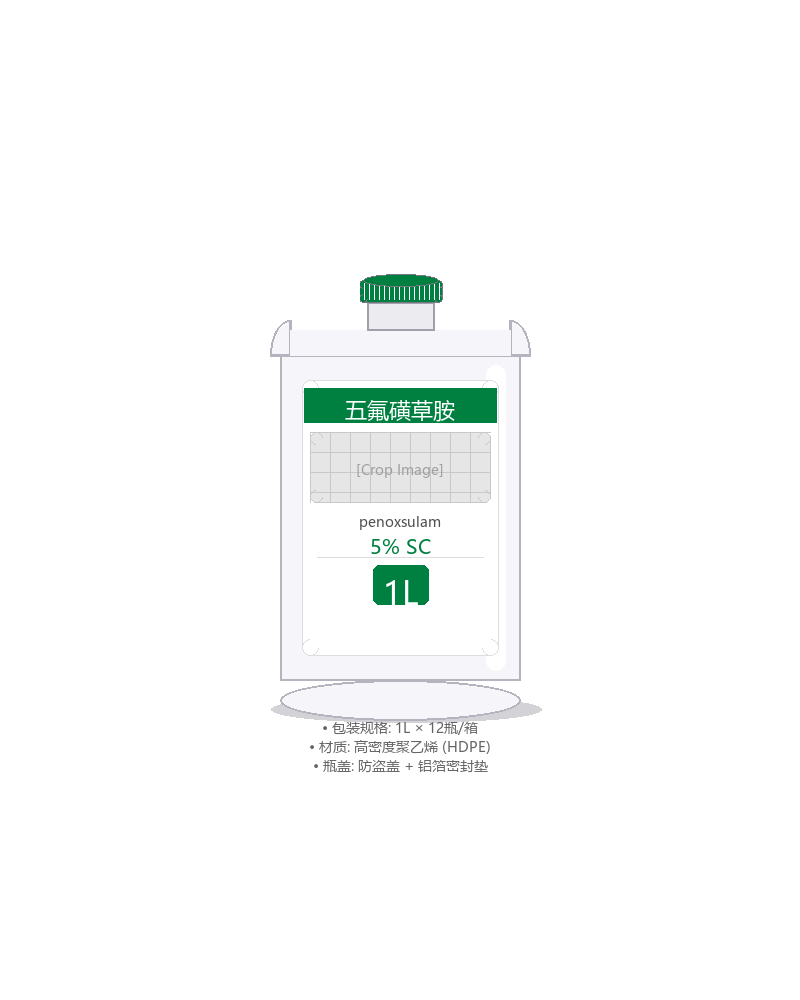
Penoxsulam 5% OD
CAS number: 219714-96-2 | Chemical Name: 2-(2,2-difluoroethoxy)-N-(5,8-dimethoxy-[1,2,4]triazolo[1,5-c]pyrimidin-2-yl)-6- (trifluoromethyl)benzenesulfonamide
I. Product Profile
Pentafluorosulfuron 5% Dispersible Oil Suspension is aA New, Highly Effective, Selective Herbicide for Rice Fields, which belongs to the triazole-pyrimidine sulfonamide class of herbicides. This product hasBroad-spectrum weed control, extremely high activity, and good safety for riceWith these characteristics, it effectively controls barnyard grass, sedge weeds, and broadleaf weeds in rice fields, and is also effective againstMature Barnyard GrassIt remains highly effective and is the product of choice for integrated weed management in rice fields.
II. Mechanisms of action of active ingredients
Target: Acetyl-L-lactate synthase (ALS) inhibitor
forms
| active link | Specific mechanisms |
|---|---|
| absorption pathway | Mainly throughFoliar Uptake by Weeds, and secondly, throughRoot Absorption, conducted through the phloem and xylem
|
| biochemical target | Inhibiting the activity of acetyl-L-lactate synthase (ALS), inhibiting the synthesis of branched-chain amino acids |
| physiological effect | Inhibits the biosynthesis of valine, leucine, and isoleucine, and prevents cell division |
| final performance | Sensitive weeds rapidly stop growing after being treated with the herbicide and gradually turn yellow and die. |
Characteristics of action
-
High conductivity: It is transported bidirectionally through the phloem and xylem within the plant and accumulates at the meristem.
-
Comprehensive Guide to Weed Control: Highly effective against barnyard grass, sedges, broadleaf weeds, and aquatic weeds
-
Effective against mature weeds: It remains effective against older barnyard grass at the 3–5-leaf stage, and the application window is broad.
-
Low toxicity and environmentally friendly: Safe for non-target organisms; environmentally friendly
III. Product characteristics
✅ Six Core Advantages
forms
| Specificities | particular |
|---|---|
| 🎯 Broad-spectrum weed control; one product, multiple uses | Highly effective against barnyard grass, sedges, broadleaf weeds, and aquatic weeds; controls the major weeds in paddy fields |
| 🔄 Works for older singles | It remains highly effective against older barnyard grass at the 3–5-leaf stage, with a wide application window and high tolerance for application errors. |
| ⏱️ Extremely active, requires only a very small amount | Excellent pest control can be achieved with extremely low doses of the active ingredient, making it both economical and environmentally friendly. |
| 🛡️ Safe for rice, highly selective | Safe for rice growth; does not affect tillering or yield |
| 💧 Dispersible oil suspension for enhanced efficacy | The OD formulation offers good dispersibility, strong adhesion, resistance to rain wash-off, and more stable efficacy. |
| 🌾 Versatile and adaptable | Can be applied as a spray or as a soil treatment; suitable for various cultivation methods |
🎯 Preventing Objects
Primary prevention and eradication: Barnyard grass (including mature barnyard grass), heteromorphic sedge, water plantain, field mustard, duckweed, jointed waterweed, water amaranth, clove smartweed, water caltrop, duckweed, and water hyssop, as well as other annual and some perennial weeds.
IV. Usage and dosage
📋 Rice field use program
forms
| Crop type | Application period | Dosage (formulated dose/acre) | water consumption | Mode of application |
|---|---|---|---|---|
| Rice transplanting field | 5–7 days after transplanting | 30–60 milliliters per mu | 30-50kg/mu | Spraying or applying toxic soil |
| Rice direct seeding field | When seedlings have 2–3 leaves | 30–60 milliliters per mu | 30-50kg/mu | Spraying or applying toxic soil |
| Rice Fields with Transplanted Seedlings | 5–7 days after transplanting | 30–60 milliliters per mu | 30-50kg/mu | Spraying or applying toxic soil |
Active ingredient dosage: The recommended application rate of the active ingredient in the field is 15–45 grams per hectare(Approx. 1–3 grams per mu).
V. Guidance for use
🔧 Application Points
forms
| move | operational specification |
|---|---|
| 1. Field preparation | Level the field and maintain a shallow layer of water (3–5 centimeters). |
| 2. Aquifer management | Maintain a water depth of 3–5 centimeters during application, and keep the water in the field for 5–7 days after application. |
| 3. Dispensing methods | Use the two-step dilution method to ensure uniform dispersion. |
| 4. Spray Quality | Apply evenly, avoiding overlapping or missed areas. |
| 5. The Poisonous Soil Method | Mix the formulation with 20–30 kilograms of fine soil per mu, and apply it evenly after the dew has dried. |
⚠️ Key Considerations
-
⏰ Grasp the application window: Apply the herbicide 5–7 days after transplanting in transplanted fields; in direct-seeded fields, apply the herbicide when the seedlings have 2–3 leaves; the best results are achieved when weeds have 2–4 leaves.
-
💧 Water Management: When applying the pesticide, make sure to3-5 cm shallow water layerPost-application water retention5-7 days, Do not drain the field or cross-irrigate during this period, and ensure that the water level does not submerge the rice plants’ young leaves.
-
🌡️ Temperature effects: The product takes effect more quickly at higher temperatures; at lower temperatures, it takes effect more slowly, but this does not affect its ultimate efficacy.
-
🚫 Contraindications: Use with caution during the rice seedling stage (before the “standing needle” stage) to avoid phytotoxicity; efficacy may be reduced in waterlogged fields or sandy soils.
-
🐟 Aquatic safety: Apply the pesticide away from aquaculture areas; do not wash application equipment in water bodies such as rivers or ponds.
-
🧪 Mixing Taboo: Do not mix with alkaline pesticides; it is recommended to rotate this product with herbicides that have different modes of action.
-
🔄 Resistance management: Long-term single use is prone to resistance, it is recommended to combine withCyanofluoroxazol, Oxazolyl-2-chlorophenoxyacetic acidRotate the use of herbicides with different modes of action, applying them no more than 1–2 times per season.
-
🛡️ security: Wear protective clothing, gloves, and a mask when applying the pesticide; wash your hands and face immediately after application; pregnant and breastfeeding women should avoid contact.
-
🧹 Instrument cleaning: Thoroughly clean the sprayer after use to prevent pesticide residue from causing phytotoxicity to subsequent crops.
-
📦 Storage conditions: Store in a cool, dry place, away from direct sunlight and high temperatures; shake the OD formulation well before use.
Sixth, product specifications and packaging
forms
| sports event | parameters |
|---|---|
| Active ingredient content | Pentafluorosulfonylurea ≥5% |
| exterior condition | A white to pale yellow, dispersible oil suspension |
| pH value | 5.0-8.0 |
| Suspension rate | ≥90% |
| Packaging specification | 100 mL × 50 bottles per case, 200 mL × 40 bottles per case, 500 mL × 20 bottles per case, 5 L × 4 buckets per case |
| date of use (on foodstuffs) | 2 years |
Warm Tip: When applying this product, please follow the guidance of your local plant protection authorities and adjust the application plan as appropriate based on local weed communities, cultivation practices, and climatic conditions.

Reviews
There are no reviews yet.