
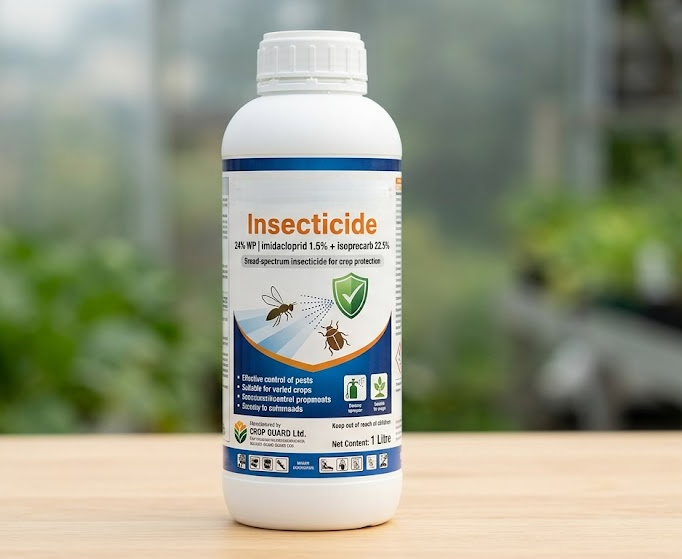
Description
Product Overview
Imidacloprid·Isoprocarb is a combination insecticide scientifically formulated by blending the neonicotinoid insecticide “Imidacloprid” with the carbamate insecticide “Isoprocarb.” The product combinesContact toxicity, stomach toxicity, and systemic translocation...It can quickly eliminate pests and provide sustained control of pest populations, and is widely used to control both piercing-sucking and chewing pests on crops such as rice, wheat, vegetables, and fruit trees.
Mechanism of Action of Active Ingredients
Imidacloprid (1.5%)
mechanism of action
Imidacloprid belongs toNeonicotinoid insecticides, which primarily acts on the nervous system of insectsNicotinic acetylcholine receptors (nAChR). Once the pesticide binds to the receptor, it continuously stimulates nerve transmission, causing the pests to become paralyzed, stop feeding, and eventually die.
Specificities
- Strong systemic activity
- Highly effective against pests with piercing-sucking mouthparts
- Longer duration of effectiveness
- It is highly effective against aphids, planthoppers, and leafhoppers.
Isoprocarb (22.5%)
mechanism of action
Isopropyl is classified asCarbamate insecticides, by inhibiting the insect'sAcetylcholinesterase activity...causing disruption of the nervous system, which rapidly paralyzes and kills the pests.
Specificities
- Highly effective against contact
- Fast knockdown speed
- Provides rapid control of pests such as rice leafhoppers
- When mixed with imidacloprid, it enhances both its rapid onset and residual efficacy.
Product Features
1. Dual Mechanism of Action
The combination of two active ingredients with different modes of action helps delay the development of pest resistance and improves the effectiveness of integrated pest management.
2. Combines fast-acting and long-lasting effects
Isopropyl quickly knocks down pests, while imidacloprid provides sustained control of pest populations, delivering dual “rapid + long-lasting” protection.
3. Broad-spectrum insecticide
Suitable for controlling a variety of sucking and some chewing pests, including:
- Rice Planthopper
- greenfly (Aphis spp.)
- Leaf Cicada
- Thrips
- Mealybugs, etc.
4. Easy to use
Wettable powders have good dispersibility and form a uniform suspension when mixed with water, making them suitable for spraying on field crops and cash crops.
5. The crop has good safety
At the recommended dosage, it is well tolerated by most common crops.
Target Pests and Application Scenarios
| crop | prevention and treatment target | Recommended Period |
| maize | Rice planthoppers, leafhoppers | Early Stage of Pest Infestation |
| Wheat | greenfly (Aphis spp.) | Early Life Stages of Insects |
| Vegetables | Aphids, whiteflies, thrips | Early Stages of Pest Infestation |
| Fruit Trees | Aphids, Leafhoppers | Peak Nymph Stage |
Directions and Dosage (for reference)
For actual use, please refer to the local registration label and plant protection guidelines.
| crop | prevention and treatment target | Recommended Dosage | Directions for Use |
| maize | Rice Planthopper | 30–45 g per mu | Spray |
| Wheat | greenfly (Aphis spp.) | 20–30 g per mu | Spray |
| Vegetables | Aphids/Whiteflies | 15–25 g per mu | mist evenly |
| Fruit Trees | Leafhoppers/Aphids | 1,000–1,500-fold dilution | Foliar Spray |
Guidelines for use
1. Optimal Application Time
It is recommended to apply the pesticide during the early nymphal stage of the pest or at the onset of an infestation to achieve better control results.
2. Scientific Rotation of Medications
To slow the development of resistance, it is recommended to rotate this product with insecticides that have different modes of action.
3. Spray evenly
When spraying, ensure that the pesticide is applied evenly to both sides of the leaves, especially in areas where pests are concentrated.
4. Avoid applying pesticides in high temperatures
It is recommended to apply the pesticide in the morning or evening to avoid high temperatures and strong sunlight, which can reduce its effectiveness.
5. Safety Measures
Applicators should wear protective gear to prevent the pesticide solution from coming into contact with their skin or eyes.
Important Notes
- Do not mix with strongly alkaline pesticides.
- Avoid contaminating water sources and aquaculture areas
- Precautions for Protecting Bees During the Flowering Season
After use, the packaging should be disposed of in accordance with regulations for pesticide waste.

Reviews
There are no reviews yet.