
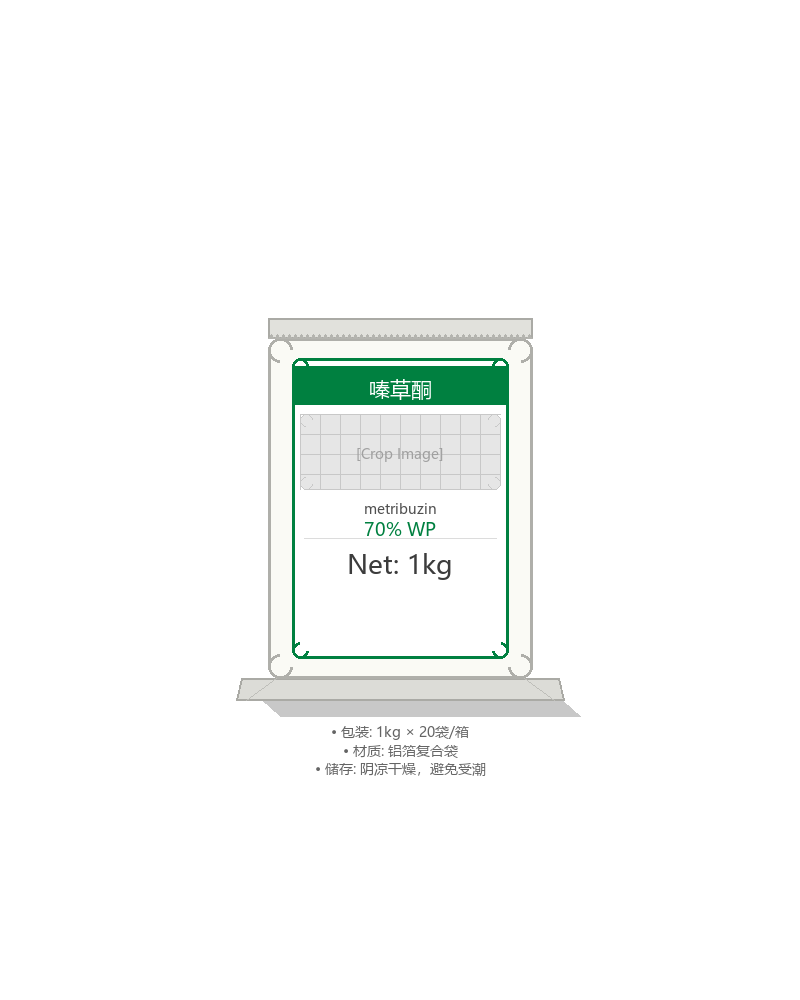
Description
Zinacloprid 70% wettable powder
Metribuzin 70% WP
CAS number: 21087-64-9 | Chemical Name: 4-Amino-6-(1,1-dimethylethyl)-3-(methylthio)-1,2,4-triazine-5(4H)-one
I. Product Profile
Quinclorac 70% wettable powder is aSelective systemic herbicides, which belongs to the triazine class of herbicides. The active ingredient is absorbed by weed roots and transported upward via transpiration, and can also be absorbed by leaves and transported to a limited extent within the plant. It exerts its herbicidal activity primarily by inhibiting photosynthesis in susceptible plants. After application, the emergence of various susceptible weeds is not affected; however, once emerged, the leaves lose their green color, and the plants eventually die from nutrient depletion. It is primarily used in soybean, potato, and tomato fields to control annual broadleaf weeds and certain grass weeds.
II. Mechanisms of action of active ingredients
Target: Photosynthesis inhibitor (PSII inhibitor)
forms
| active link | Specific mechanisms |
|---|---|
| absorption pathway | The active ingredient is absorbed by the roots of weeds and transported upward via transpiration; it can also be absorbed by the leaves and transported to a limited extent within the plant. |
| biochemical target | Inhibition of QB proteins in the photosynthetic electron transport chain, blocking the transfer of electrons from QA to QB |
| physiological effect | Inhibits photosynthesis in weeds, preventing the synthesis of organic compounds (ATP and NADPH) |
| final performance | After germination, the leaves of the weeds lose their green color, the edges turn yellow or take on a scorched appearance, and the plants eventually die from starvation. |
Characteristics of action
-
The emergence of various susceptible weeds is not affected by the application of the herbicide; symptoms only become apparent after they have emerged.
-
Symptoms include yellowing or scorched-looking leaf margins; the entire leaf may turn yellow, but the veins often retain a pale green color (interveinal chlorosis).
-
The residual efficacy in soil is influenced by climatic conditions and soil type; the half-life is typically around 28 days.
III. Product characteristics
✅ Six Core Advantages
forms
| Specificities | particular |
|---|---|
| 🎯 Broad-spectrum weed control; effective against both grass and broadleaf weeds | It provides good control of a wide range of annual broadleaf weeds and some grass weeds. |
| 🔄 Systemic action, thoroughly eradicates | Once absorbed by the roots, it travels upward, destroying weeds from the inside out, with no regrowth |
| ⏱️ Moderate duration of action; safe and controllable | The half-life in soil is approximately 28 days, and it does not cause phytotoxicity to subsequent crops. |
| 🛡️ Safe for crops, highly selective | Safe for crops such as soybeans and potatoes at the recommended dosage |
| 💧 Versatile—can be used before or after planting | Can be applied as a soil treatment or as an early post-emergence foliar treatment |
| 🌾 Excellent compatibility and flexible options | May be mixed with fluazifop, metolachlor, acetochlor, atrazine, and other similar herbicides |
🎯 Preventing Objects
Pre-emergence low dose (23 grams of active ingredient per mu): Perennial ryegrass, wild wheatgrass, redroot pigweed, burdock, wolf's-bane, shepherd's purse, cornflower, Amaranth, Lesser Amaranth, Wild Sesame, Water Parsley, Mallow, Shepherd’s Purse, Sorrel, Spring Smartweed, Red Smartweed, Wild Mustard, Purslane, Chickweed, and Blue-eyed Susan, among others.
High dose during the seedling stage (35–47 grams of active ingredient per mu): Barnyard grass, pigweed, spiny amaranth, green amaranth, pansy, water spiny restharrow, elsholtzia, datura, weasel-flower, shepherd's purse, willow-leaved smartweed, chickweed, duckweed, foxtail grass, barnyard grass, ramie, curled-stem smartweed, cocklebur, etc.
Suitable crops: Soybeans, potatoes, tomatoes, alfalfa, corn, sugarcane, asparagus, pineapples, etc.
IV. Usage and dosage
📋 Soybean Field Application Plan
forms
| Soil organic matter content | Soil texture | Dosage (formulated dose/acre) | Mode of application |
|---|---|---|---|
| <2% | loamy soil | 40–50 grams per mu | Post-sowing, pre-emergence soil spray |
| <2% | Clay soil | 50–70 grams per mu | Post-sowing, pre-emergence soil spray |
| 2%-4% | loamy soil | 50–70 grams per mu | Post-sowing, pre-emergence soil spray |
| 2%-4% | Clay soil | 70–80 grams per mu | Post-sowing, pre-emergence soil spray |
| >4% | loamy soil | 70–80 grams per mu | Post-sowing, pre-emergence soil spray |
| >4% | Clay soil | 70–90 grams per mu | Post-sowing, pre-emergence soil spray |
📋 Guidelines for Potato Fields
forms
| Application period | Dosage (formulated dose/acre) | water consumption | Mode of application |
|---|---|---|---|
| After sowing and before emergence | 66–76 grams per mu | 30 kilograms per mu | Soil spraying |
📋 Application Guidelines for Corn Fields
forms
| Application period | Dosage (formulated dose/acre) | Mode of application |
|---|---|---|
| post-sowing before seedling(Soil organic matter > 21% by weight, pH < 7) | At the recommended dose | Soil spray; may be mixed with acetochlor, atrazine, and other similar products |
Active ingredient dosage: The recommended application rate of the active ingredient per mu for spring soybean fields is 28–63 grams per mu...adjust according to soil organic matter content and texture. Use the lower limit for soils with low organic matter content and sandy soils; use the upper limit for soils with high organic matter content and clay soils.
V. Guidance for use
🔧 Application Points
forms
| move | operational specification |
|---|---|
| 1. Seize the opportunity | Soil treatment before or after soybean sowing, up to 3–5 days before emergence |
| 2. Soil moisture | The soil must be sufficiently moist, or irrigation must be performed after application; under dry conditions, mixing with other herbicides yields good control results. |
| 3. Dispensing methods | Using the two-step dilution method, first mix with a small amount of water to form a paste, then add water to dilute it |
| 4. Spray evenly | Mix with about 30 kilograms of water per mu and spray evenly over the soil surface. |
⚠️ Key Considerations
-
⏰ Optimal application period: soybeanspost-sowing before seedlingWhen used during the seedling stage, it may cause phytotoxicity.
-
🚫 Unsuitable soils: Sandy soils with organic matter content below 21% should not be used.; Under conditions where the pH is greater than 7 and soil organic matter is less than 21% (TP3T), applying the herbicide after seeding but before emergence is prone to causing leaching damage if heavy rain occurs.
-
🌡️ Risk of phytotoxicity: Pesticide damage to soybeans can occur under conditions such as excessive pesticide application, poor drainage in low-lying areas, waterlogged fields, high humidity and low temperatures, or pest and disease infestations that impair soybean growth and development. Mild cases may result in dark green, shriveled leaves, while severe cases may lead to chlorosis, yellowing, and brown necrosis of the leaves.
-
💧 Drainage requirements: Applying this herbicide in low-lying areas, under cold and humid conditions, or during the soybean emergence stage—especially when mixed with 50% (acetochlor)—can exacerbate phytotoxicity and significantly reduce yields.
-
🐟 Aquatic safety: Apply the pesticide away from aquaculture areas, and do not wash application equipment in water bodies such as rivers or ponds.
-
🧪 Mixing Taboo: Do not mix with alkaline substances such as pesticides.
-
🔄 Variety sensitivity: Certain soybean varieties may be sensitive to quinclorac; a sensitivity test should be conducted before use.
-
🛡️ security: When applying the product, wear long sleeves and pants, gloves, and a mask; do not smoke or eat or drink. After application, immediately wash exposed skin, used equipment, and contaminated clothing.
-
🧹 Instrument cleaning: Wastewater from cleaning medical equipment must not be discharged into water sources such as rivers or ponds; waste must be disposed of properly and must not be discarded carelessly.
-
📦 Storage conditions: Store in a cool, dry, well-ventilated place, away from direct sunlight and high temperatures; keep away from sources of fire and out of the reach of children.
Sixth, product specifications and packaging
forms
| sports event | parameters |
|---|---|
| Active ingredient content | Quinaceton ≥70% |
| exterior condition | White to pale yellow powder |
| Suspension rate | ≥70% |
| Wetting time | ≤120 seconds |
| Packaging specification | 50 g × 100 bags per case, 100 g × 50 bags per box, 500 g × 20 bags per box |
| date of use (on foodstuffs) | 2 years |
Warm Tip: For specific application, please use under the guidance of local plant protection department and adjust the dosing program appropriately according to local weed communities, soil types and climatic conditions.
Reviews
There are no reviews yet.