
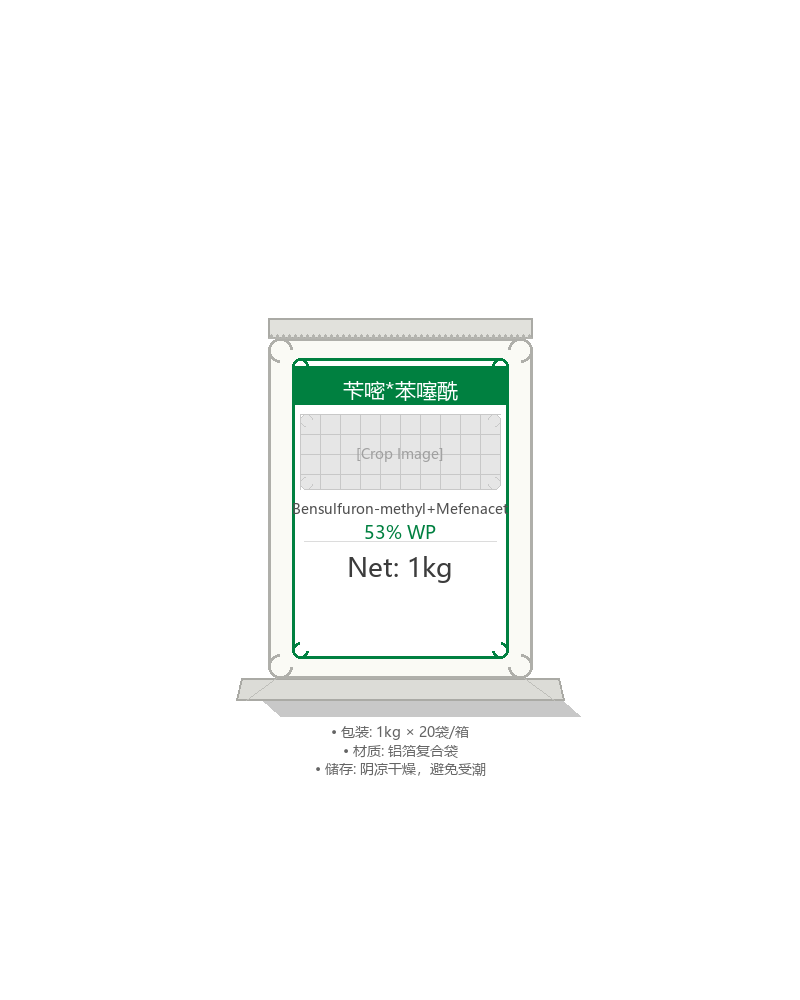
Benzylpyrim*benzothioyl 53% wettable powder
$0.00
Benzylpyrimidine*benzothioyl
Out of stock
Find more products
Description
Benzylpyrimidine·Benzothiazole 53% Wettable Powder
Bensulfuron-methyl + Mefenacet 53% WP
Pesticide Category: Herbicides Dosage form: Wettable Powder (WP) | Toxicity: lower toxicity
Active ingredients: Benzylsulfuron + Benzothiazolylglyoxymide | Total active ingredient content: 53%
Active ingredients: Benzylsulfuron + Benzothiazolylglyoxymide | Total active ingredient content: 53%
I. Product Profile
Benzylpyrimidine·Benzothiazole 53% Wettable Powder is aBinary Formulation Herbicide Specifically Designed for Rice Fields, bySulfonylurea-based broadleaf sedge herbicide (benzothiadiazole)andAmide-type mitosis inhibitors (benzothioxyl-2,4-dichlorophenoxyacetic acid)Scientifically formulated. This product isSingle-application herbicide...It provides excellent control of most annual weeds and some perennial weeds in rice fields, combining both ”pre-emergence and systemic” modes of action, making it a highly effective solution for integrated weed management in transplanted and direct-seeded rice fields.
II. Mechanisms of action of active ingredients
Mechanism of dual-target synergy
forms
| Ingredients | Function Category | mechanism of action | Mechanism of action |
|---|---|---|---|
| Bensulfuron | HRAC Class B / WSSA Class 2 | Acetyl-L-lactate synthase (ALS) inhibitors, inhibiting the synthesis of branched-chain amino acids | Systemic, absorbed by roots and leaves |
| Benzothiazolylglyoxamide | HRAC Category K3 / WSSA Category 15 | Cell division inhibitor, interfering with the synthesis of very-long-chain fatty acids | Pre-sprout soil treatment; absorption by young sprouts |
The Principle of Synergy
-
Broadleaf Cyperus Herbicide (Benzylsulfuron): It selectively inhibits the biosynthesis of the essential amino acids valine and isoleucine in organisms, thereby preventing cell division and halting plant growth. It is a systemic herbicide; the active ingredient is absorbed by the leaves and roots and moves rapidly through the meristematic tissues. It is highly effective against duckweed, water caltrop, water parsnip, and other weeds, as well as Cyperaceae weeds.
-
Grass-Species Pre-emergence (Bentazone): It is absorbed by young weed seedlings, inhibits cell division, and disrupts the synthesis of very-long-chain fatty acids, causing the young weed seedlings to die from poisoning before they emerge from the soil. It is highly effective against grass weeds such as barnyard grass and crabgrass.
-
Synergy: Benzylsulfuron compensates for the poor efficacy of benzothiadiazoxyl against broadleaf weeds and sedge weeds; Benzothiadiazoxam compensates for benzosulfuron’s poor efficacy against barnyard grass, thereby achieving complete control of grass, broadleaf, and sedge weeds in rice fields.
III. Product characteristics
✅ Six Core Advantages
forms
| Specificities | particular |
|---|---|
| 🎯 One-time weed control—saves labor and time | A single application effectively controls weeds throughout the entire rice growing season, reducing the number of applications required. |
| 🔄 Hekuosha: Complete Control, Broad-Spectrum and Highly Effective | It provides excellent control of grass weeds, broadleaf weeds, and sedge weeds, covering the major weeds found in rice fields. |
| ⏱️ Long lasting, one time for the whole season. | It has a long residual effect, and a single application is generally sufficient to control weeds throughout the entire growth cycle of rice. |
| 🛡️ Safe for rice, highly selective | It is safe for rice growth at the recommended dosage and does not affect tillering or yield. |
| 💧 Flexible and versatile | Can be applied as a soil treatment or sprayed; suitable for various cultivation methods, including transplanting and direct seeding. |
| 🌾 Suitable for both the north and south, with a wide coverage area | There are recommended application rates for both southern and northern regions, making it highly adaptable. |
🎯 Preventing Objects
Primary prevention and eradication: Annual and some perennial weeds, such as barnyard grass, golden needle, cowhair grass, odd-leaved sedge, broken-grain sedge, duck’s-beak grass, jointed grass, field grass, water amaranth, water milfoil, green duckweed, and water snakegourd.
Suitable crops: Rice transplanting fields and direct-seeding rice fields.
IV. Usage and dosage
📋 Rice field use program
forms
| Crop type | Application period | Dosage (formulated dose/acre) | Water Body Management | Mode of application |
|---|---|---|---|---|
| Rice Fields with Transplanted Seedlings | 7–10 days after transplanting, once the rice seedlings have taken root and become well-established, | 45–50 grams per mu | Maintain a water depth of 3–4 cm before application, and keep the soil moist for 5–7 days after application. | Poison Soil Technique |
| Rice Transplanting Fields (Southern Regions) | 5–7 days after transplanting | 45–50 grams per mu | Maintain a water depth of 3–4 cm before application, and keep the soil moist for 5–7 days after application. | Poison Soil Technique |
| Rice Transplanting Fields (Northern Region) | 5–7 days after transplanting | 70–80 grams per mu | Maintain a water depth of 3–4 cm before application, and keep the soil moist for 7–10 days after application. | Poison Soil Technique |
| Direct-Seeded Rice Fields (Southern Regions) | Rice seedlings at the two-leaf-one-heart stage; early stage of weed emergence | 45–50 grams per mu | Maintain a water depth of 3–4 cm before application, and keep the soil moist for 5–7 days after application. | Poison Soil Technique |
Dosage Instructions: Due to differences in climate, soil, and other conditions, the application rate in northern regions should be slightly higher than in southern regions; use the upper limit of the recommended rate when barnyard grass is at an advanced growth stage, and the lower limit when it is at an early growth stage.
V. Guidance for use
🔧 Application Points
forms
| move | operational specification |
|---|---|
| 1. Seize the opportunity | For direct-seeding fields, apply the pesticide after the rice seedlings have taken root and become well-established; for transplanted fields, apply the pesticide 5–7 days after transplanting; for direct-seeding fields, apply the pesticide when the seedlings are at the two-leaf-one-heart stage. |
| 2. Weed Leaf Stage | Pesticides are most effective when applied before the two-leaf stage of barnyard grass; the younger the weed, the better. |
| 3. Aquifer Management | Before application, maintain a water depth of 3–4 centimeters in the field; after application, maintain the water level for 5–7 days, taking care not to submerge the rice plant’s terminal leaf. |
| 4. Preparation of Toxic Soil | First, mix this product thoroughly with a small amount of moist fine soil (sand), then blend it evenly with the remaining moist fine soil (sand) or chemical fertilizer, and apply it evenly. |
| 5. Apply the pesticide evenly | Ensure that the pesticide is evenly distributed over the field to avoid over-spraying or missed spots. |
⚠️ Key Considerations
-
⏰ Grasp the application window: In fields where rice seedlings are transplanted, the seedlings must beAfter the sapling has taken rootApplying pesticides before the plants have taken root can easily cause phytotoxicity; in direct-seeding fields,Seedlings at the 2-leaf-and-1-heart stageApplying the pesticide too early can cause phytotoxicity.
-
💧 Water Management: Maintain the following during and after application:3–5 cm water depth, 5–7 daysIf there is a water shortage, water the field gradually; do not drain the field, and ensure that the water level does not submerge the rice plants’ terminal leaves.
-
🌱 Age of barnyard grass: Use the upper limit of the recommended dose when barnyard grass is at an advanced growth stage, and the lower limit when it is at an early growth stage; efficacy decreases when barnyard grass has more than three leaves.
-
🚫 Prohibited plots: This product is ineffective on sandy soils and waterlogged fields and is not recommended for use in such conditions; late-season rice varieties (japonica and glutinous rice) are relatively sensitive, so application during the budding stage of late-season rice should be avoided as much as possible.
-
🐟 Aquatic safety: This product is low in toxicity to bees, fish, and other aquatic organisms, as well as silkworms; however, keep away from aquaculture areas during application.
-
🧪 Mixing Taboo: Do not mix with alkaline pesticides; it is recommended to rotate this product with herbicides that have different modes of action.
-
🔄 Resistance management: Long-term single use is prone to resistance, it is recommended to combine withPropachlor, OxazoloneRotate the use of herbicides with different modes of action, applying them no more than once per season.
-
🛡️ security: When using this product, wear protective clothing and gloves to avoid inhaling the solution; do not eat, drink, or smoke while applying the product; wash your hands and face immediately after application.
-
🧹 Waste Management: To protect the environment, packaging materials must be disposed of properly; they must not be discarded carelessly, nor used to store other pesticides or food.
-
📦 Storage conditions: Store in a cool, dry, well-ventilated place, away from direct sunlight and high temperatures; keep away from sources of fire and out of the reach of children.
Sixth, product specifications and packaging
forms
| sports event | parameters |
|---|---|
| Total active ingredient content | 53% (benzoylsulfuron + benzothiazolylsulfuron) |
| exterior condition | Grayish-white to pale yellow powder |
| Suspension rate | ≥70% |
| Wetting time | ≤120 seconds |
| Packaging specification | 50 g × 100 bags/package, 100 g × 50 bags/box, 500 g × 20 bags/box, 25 kg/bag |
| date of use (on foodstuffs) | 2 years |
Warm Tip: When applying this product, please follow the guidance of your local plant protection authorities and adjust the application plan as appropriate based on local weed communities, cultivation practices, and climatic conditions.

Reviews
There are no reviews yet.