
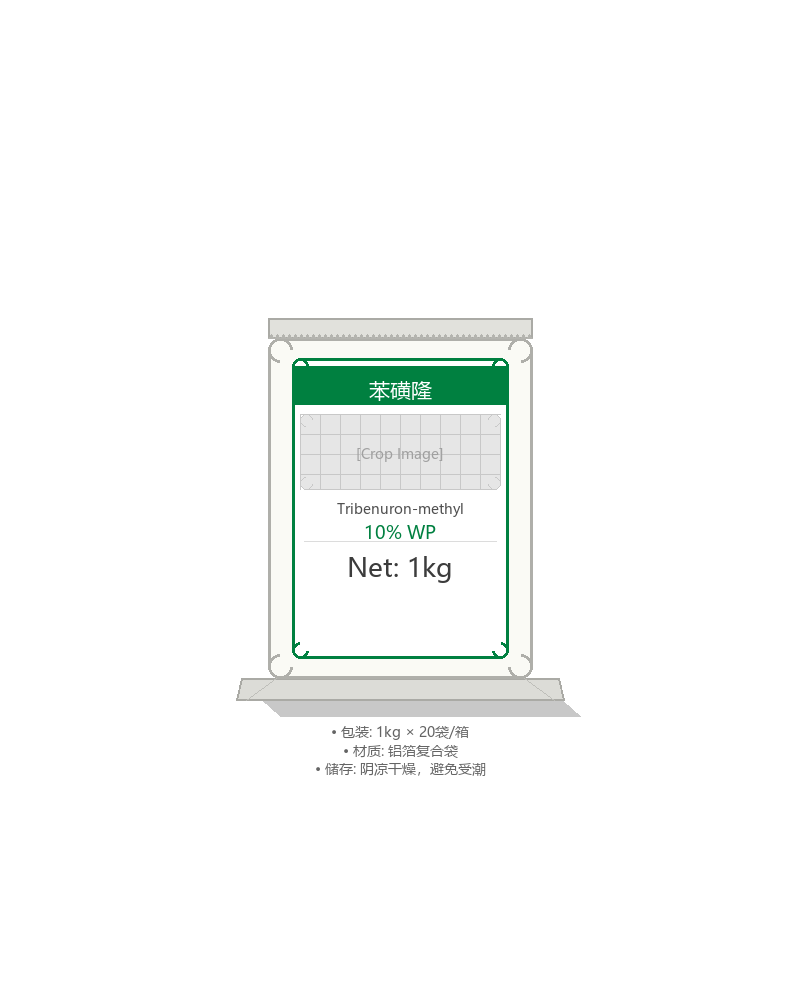
Description
Benzenesulfuron 10% WP
Tribenuron-methyl 10% WP
CAS number: 101200-48-0 | Chemical Name: Methyl 2-{[(4-methoxy-6-methyl-1,3,5-triazine-2-yl)carbamoyl]aminosulfonyl}benzoate
I. Product Profile
Bensulfon 10% Wettable Powder is aSelective systemic herbicides, a sulfonylurea herbicide. This product is absorbed by the roots and leaves of weeds and is translocated throughout the plant; sensitive weeds cease growth immediately after absorbing the herbicide and die within 1–3 weeks. It is primarily used to control annual broadleaf weeds in winter wheat fields and hasHigh activity, low dosage, low residue, excellent compatibility, and high cost-effectivenessWith these features, it is a classic product for controlling broadleaf weeds in wheat fields.
II. Mechanisms of action of active ingredients
Target: Acetyl-L-lactate synthase (ALS) inhibitor
forms
| active link | Specific mechanisms |
|---|---|
| absorption pathway | Overgrown with weedsRoot and Leaf Uptake, and is transported within the plant |
| biochemical target | Inhibiting the activity of acetyl-L-lactate synthase (ALS), inhibiting the biosynthesis of branched-chain amino acids (valine, leucine, and isoleucine) |
| physiological effect | Interferes with protein synthesis and inhibits cell division and growth |
| final performance | Sensitive weeds stop growing immediately after absorbing the herbicide and die within 1–3 weeks. |
selectivity principle (physics)
-
Wheat has an ”antidote mechanism” that allows it to metabolize the components of bensulfuron, making it safe for wheat seedlings.
-
It breaks down relatively quickly in the soil—even faster in acidic soil—and various crops can be planted as usual 90 days after application at the recommended rate.
-
Suitable for use in wheat fields in regions with multiple harvests
III. Product characteristics
✅ Six Core Advantages
forms
| Specificities | particular |
|---|---|
| 🎯 Targets broadleaf weeds exclusively, completely eliminates weeds | Highly effective against broadleaf weeds in wheat fields such as common mugwort, shepherd’s purse, and pigweed; kills weeds completely with no regrowth. |
| 🔄 Systemic action, thoroughly eradicates | After being absorbed by the roots and leaves, the product is transported throughout the plant, destroying weeds from the inside out, with no regrowth. |
| ⏱️ Extremely active, requires only a very small amount | Excellent pest control efficacy can be achieved with extremely low doses of the active ingredient, in line with the national policy on reducing pesticide use. |
| 🛡️ Safe for wheat, suitable for subsequent crops | Safe for wheat, breaks down quickly in the soil, and is friendly to subsequent crops |
| 💧 Highly compatible and flexible solutions | Can be mixed with a variety of herbicides to broaden the spectrum of weed control and adapt to the weed communities in different regions |
| 🌾 Great value for the price; affordable | With its low cost per unit of application, it is an economical choice for controlling broadleaf weeds in wheat fields. |
🎯 Preventing Objects
Primary prevention and eradication: Annual broadleaf weeds such as common ragweed, shepherd’s purse, pigweed, wild rapeseed, chickweed, wheatgrass, water sumac, veronica, ox-tongue, greater chickweed, quinoa, and smartweed. It is also effective against field morning glory, iron amaranth, prickly amaranth, and curled-stem smartweed.
Suitable crops: Fields of winter wheat, barley, and oats.
IV. Usage and dosage
📋 Application Guidelines for Winter Wheat Fields
forms
| Application period | Dosage (formulated dose/acre) | water consumption | Mode of application |
|---|---|---|---|
| Wheat: From the two-leaf stage to before the jointing stage(Weeds at the 2–4-leaf stage) | 10–20 grams per mu | 30-40 kg/mu | Foliar spray |
Active ingredient dosage: The application rate of the active ingredient per mu is 1–2 grams per mu. The best results are achieved when the herbicide is applied when the weeds are at the 3- to 4-leaf stage, using no less than 30 kilograms of water per mu. Adding 0.21 TP3T of nonionic surfactant per unit of water can help improve control efficacy.
V. Guidance for use
🔧 Application Points
forms
| move | operational specification |
|---|---|
| 1. Seize the opportunity | Apply the herbicide from the two-leaf stage of wheat until the jointing stage, and when annual broadleaf weeds have fully emerged and are at the 2–4-leaf stage. |
| 2. Method of Dosing | Using the two-step dilution method, first thoroughly disperse the chemical in a small amount of water, then add sufficient water. |
| 3. Add additives | Add 0.21–3 T of nonionic surfactant per unit of water to enhance the protective effect. |
| 4. Spray evenly | Mix with at least 30 kilograms of water per mu and spray evenly on the stems and leaves. |
⚠️ Key Considerations
-
⏰ Optimal application period: WheatFrom the two-leaf stage to before the jointing stage, annual broadleaf weeds2–4-leaf stage after emergenceThis provides the best results.
-
🚫 Taboos During the Joint-Stretching Phase: Use is strictly prohibited after wheat enters the jointing stage., otherwise it may cause phytotoxicity.
-
🌡️ Drift Risk: When spraying, care should be taken to prevent spray drift onto nearby broad-leaved flowers to avoid phytotoxicity.
-
💧 Water consumption: Water consumption per muNo less than 30 kilograms, ensuring that the herbicide solution evenly covers the entire weed plant.
-
🐟 Aquatic safety: Apply the pesticide away from aquaculture areas, and do not wash application equipment in water bodies such as rivers or ponds.
-
🧪 Blending recommendations: can be used withQuinclorac, FluoroxypyrMix with other herbicides to broaden the spectrum of weed control. When mixed with fluazifop-p-butyl, weed control efficacy against broadleaf weeds in wheat fields can reach 92.61 TP3T or higher.
-
🔄 Resistance management: Cases of resistance have been reported in some areas; it is recommended to rotate this herbicide with others that have different modes of action.
-
🛡️ security: Wear protective clothing, gloves, and a mask when applying the pesticide; wash your hands and face immediately after application; pregnant and breastfeeding women should avoid contact.
-
🧹 Instrument cleaning: Thoroughly clean the sprayer after use to prevent residual pesticide from causing phytotoxicity to other crops.
-
📦 Storage conditions: Store in a cool, dry, well-ventilated place, away from direct sunlight and high temperatures; keep away from sources of fire and out of the reach of children.
Sixth, product specifications and packaging
forms
| sports event | parameters |
|---|---|
| Active ingredient content | Bensulfuron ≥10% |
| exterior condition | White to pale yellow powder |
| Suspension rate | ≥70% |
| Wetting time | ≤120 seconds |
| Packaging specification | 10 g × 200 bags per case, 15 g × 200 bags per case, 20 g × 100 bags per case, 100 g × 50 bags per box |
| date of use (on foodstuffs) | 2 years |
Warm Tip: When applying the product, please follow the guidance of your local plant protection authorities and adjust the application plan as appropriate based on local weed communities and climatic conditions.
Reviews
There are no reviews yet.